Natural ventilation: types, opportunities, and challenges
Natural ventilation is essential in today's buildings. While in the past, air renewal occurred even in closed rooms - due to leaks generated in walls, doors or windows - nowadays buildings incorporate thermal insulation systems that prevent outside air from entering unwantedly. This way, greater energy efficiency is achieved and we have better living conditions: we suffer less from heat or cold indoors. But we need systems that guarantee air renewal, whether they are natural ventilation or mechanical solutions.
For the necessary air renewal - without which we may suffer health problems at home - we can use mechanical or natural systems. The main differences are:
- Mechanical ventilation systems. These are systems where at least the air extraction is done mechanically, using fans. The admission of air can be done through grills that connect to the outside, or it can also be done mechanically, which would be dual-flow ventilation, the most complete solution to ensure proper airflow indoors and improve energy efficiency with heat recovery.
- Natural ventilation systems. In this case, it is a passive ventilation solution, as no mechanical elements are used. The cost is zero, as the circulation and renewal of air occur naturally.
 Does that mean we should abandon natural ventilation systems? Not at all. Above all, because we can combine them with mechanical solutions to improve energy efficiency and depend less on mechanical solutions. Likewise, hybrid systems use many natural elements, so natural ventilation still has much to say. In addition to being a great option for the rehabilitation of old buildings.
What is natural ventilation?

We could say that natural ventilation is a spontaneous phenomenon, as we cannot control when it is activated or under what conditions. Moreover, it is also a passive solution, as we do not have to start anything for it to work. This has the advantage that it incurs no energy cost, making it totally eco-friendly.
In the spontaneity of natural ventilation, we cannot choose how to ventilate or when to do it. This is why situations may arise where there is excess or lack of air renewal. Because air and temperature control outdoors is something that cannot be manipulated. And that is precisely why the administration specifies that the minimum required legally is that of hybrid ventilation, as it offers us the benefits of the natural system while still being sufficient, leaving mechanical solutions for those situations where natural ventilation is not sufficient.
The strengths and weaknesses of natural ventilation are basically as follows:
- It incurs no cost. From an energy standpoint, natural ventilation is passive and generates no expense. In optimal conditions, we can achieve home comfort completely eco-friendly. If we are in windy areas, we may be able to take advantage of this circumstance.
- However, we have no control over natural ventilation. And this can be a problem at home, as if air renewal does not occur when necessary, we may suffer respiratory problems or others caused by issues like humidity or stale air.
Types of natural ventilation

The difference in pressure between two areas, the rise of hot air, or simply the passage of wind. These three phenomena are the main ones in the air renewal through natural ventilation. Although it is a passive phenomenon that must occur naturally and in which we cannot interfere, we can facilitate its formation or the efficiency that we need.
Some of the techniques that can help us with natural ventilation to enhance it or make better use of its options are the following:
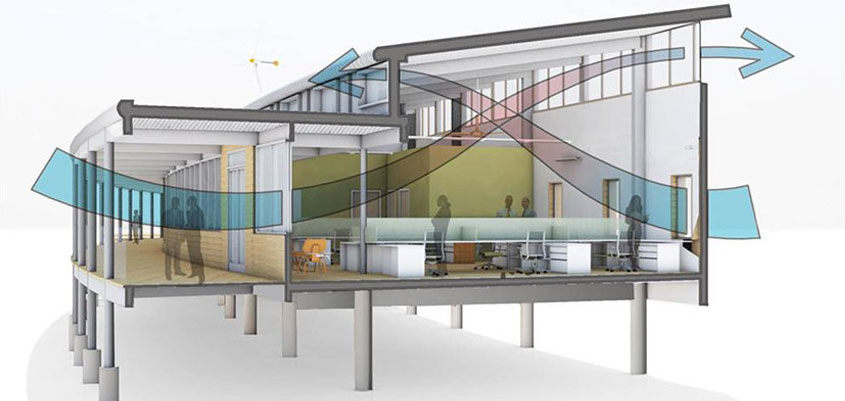
- Natural cross ventilation. If you've ever opened a door leading to the outside that was located in front of an open window, you surely felt a strong draft. This phenomenon is that of cross ventilation, which works by creating a strong airflow between two opposing points that communicate with the outside. Cross ventilation can be planned from the architecture of the building, and its use is indicated in warm climates. Not only does it renew the air in that space, but this type of natural ventilation also consistently lowers the temperature and above all the thermal sensation thanks to the airflow. It would be like having a large fan that could send air throughout the room.
- Induced natural ventilation. In this case, the phenomenon of hot air rising is leveraged. This is because warm air is lighter than cold air; both outdoors and indoors, the normal behavior is that cold air sinks and warm air rises. Induced natural ventilation can be forced through openings near the ground so that the cold air enters the rooms, pushing the volume of warm air upwards. Air outlets are placed at the ceiling level. This system of natural air renewal works very well in large spaces and areas with high ceilings, especially in warm climates.
- Chimney effect. This is created through a ventilated cover that is placed like a wall in front of the main wall, leaving a space for air passage. Air intakes are placed at the lower part of this facade and outlets at the upper part. The chimney effect is the phenomenon that occurs as a response to the heating of the outer layer. The density of the air changes, creating an upward movement through natural convection, thanks to temperature differences. Similar to induced natural ventilation. In winter, it allows significant heating of the rooms, and in summer, it helps cool the home.
- Evaporative cooling systems. These are natural ventilation solutions exclusively for large buildings and complex architectural designs, especially in dry climates. In evaporative cooling, large bodies of water are used near airflow, with specific placement in front of buildings with openings. The wind, after passing by the water, gains a percentage of humidity that ensures greater sensation of freshness in arid climates.
However, the most important factor is usually the placement of air intakes and outlets, as they must be strategically placed based on the wind passing through the area. Doors or vents in each of the rooms will also be important, so a comprehensive study of the project must be taken into account.
Challenges of natural ventilation

Among the issues that natural ventilation may present is the dependence on windows. Mechanical ventilation systems not only renew the air as necessary and automatically, but they also allow us to forget about the outside weather, as they work with the windows closed, regardless of whether it is windy or not, cold or hot.
Natural ventilation, on the other hand, forces us to open the windows in many cases. This means that we also suffer from external pollution and have more exposure to heat and cold in summer and winter. However, the major issue with natural ventilation is always the reliance on mother nature.
The solution for these cases is to combine natural systems with mechanical ones, which is called hybrid ventilation. Since in these situations, we will have natural air renewal as long as conditions allow, and we will rely on mechanical systems only when strictly necessary. Likewise, natural ventilation systems are ideal when faced with a renovation, as many old properties make remodeling very difficult. We can take into account the possibilities of natural ventilation.
It should be noted that dual-flow ventilation systems are the most advanced solution for air renewal - for example, energy mortgages offer the greatest discounts for energy efficiency only if a dual-flow solution is installed - but options for natural ventilation can also be very useful to install alternatives that improve efficiency at home without the need for energy consumption.


Siber Ventilation
Related posts
Why is mechanical ventilation necessary in homes?

Constant flow ventilation systems, how do they work?