Controlled Mechanical Ventilation (VMC) in Nearly Zero Energy Buildings
Currently, the buildings being constructed must aim for greater tightness. This means they must be much more resistant to the elements and not allow external impurities to enter the home. It is a way to make homes and also workplaces much safer for our respiration and also very economical in relation to energy. However, it is necessary that all air that moves indoors is introduced or extracted mechanically, by electricity. This is what we know as controlled mechanical ventilation (VMC). And it will be one of the most common installations in the very near future. In fact, VMC is already more of a present than a future.
Both in the Technical Building Code (CTE), within the Basic Document HS3, as well as in the RITE, it is explained that every newly constructed building must have a ventilation system and that it must be mechanical in some of its parts. But this will become more important starting in 2020, when the obligation for all newly constructed homes and offices to be Nearly Zero Energy Buildings will come into effect. For this, the use of controlled mechanical ventilation (VMC) systems will be necessary.
Thanks to mechanical ventilation, we can ensure health in the home, in addition to making air conditioning systems energy efficient. With this, it is possible to keep windows closed - a requirement of ventilation systems - which also reduces noise from outside. And it is also possible for the outside air to enter the rooms previously filtered to thus improve the safety of those who inhabit the buildings.
There are controlled mechanical ventilation (VMC) systems that are hybrid, with natural intake and mechanical extraction, for example. Or that both the intake and exhaust of air are automatically regulated, adapting to the needs of each of the rooms.
What main types of VMC systems can be found?
- Mechanical ventilation systems for intake. These are solutions in which air is extracted naturally, usually using grilles and infiltrations. The intake of air from the outside is done through fans that push it into the rooms.
- Mechanical ventilation systems for extraction. In this case, the intake of air is done from the outside naturally thanks to intake grilles that connect with each of the rooms. To exhaust the air, we have controlled mechanical ventilation (VMC), which will eliminate air that may be stored in the homes or buildings, thus renewing it and eliminating its impurities.
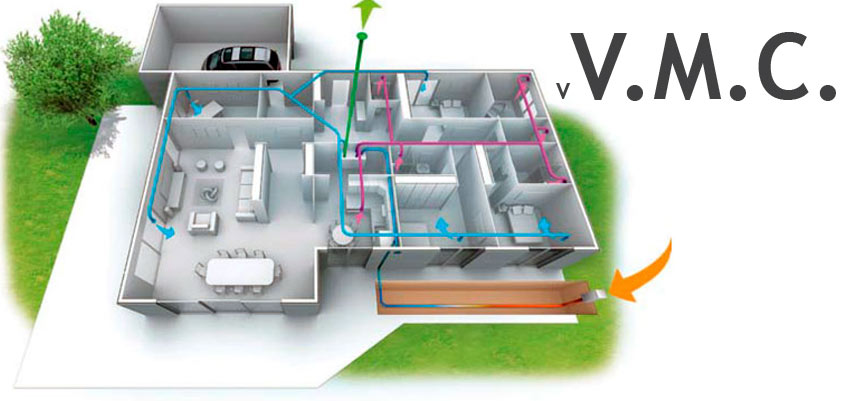
- Mechanical ventilation systems for both extraction and intake. These are more commonly known as double flow mechanical ventilation systems. Both the intake and extraction of air are done mechanically with fans. They are the safest and most advanced option, as they allow for complete regulation of air renewal. The air enters filtered and is of the highest quality, in addition to being the systems with the highest energy efficiency. In winter, it is possible to heat the air entering the home, and in summer, cool it, thus avoiding the use of air conditioning systems.
Energy efficiency in controlled mechanical ventilation (VMC)
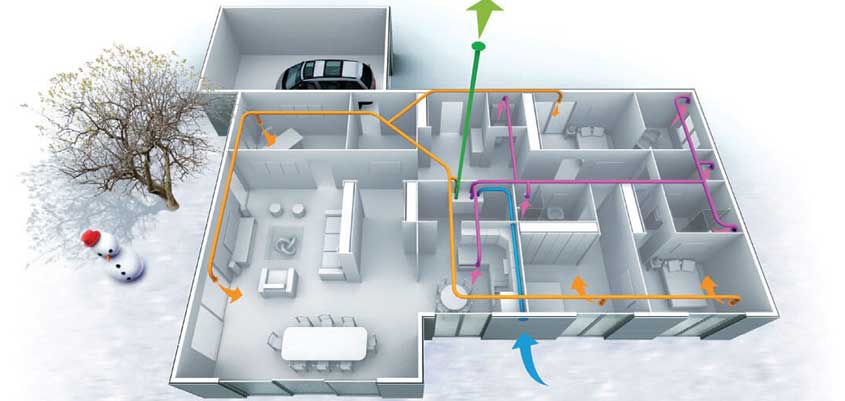
As we have said, starting in 2020 all constructions carried out in Spain must comply with the criteria for Nearly Zero Energy Buildings. For this, controlled mechanical ventilation (VMC) is essential, as through it we can improve energy expenditure and reduce it to a minimum.
Double flow mechanical ventilation systems may have a heat recovery unit, allowing them to heat the air that enters the rooms from the outside, even if it is at very low temperatures. This allows that, indoors, we don’t have to use traditional heating systems in most cases.
Likewise, the air in summer is cooled before entering the rooms, pushed from the outside, so the use of air conditioning is also avoided.
The air is filtered in double flow mechanical ventilation systems, so in addition, the air breathed indoors is of much higher quality compared to what can be found outdoors.
The present and future of construction lies in controlled mechanical ventilation (VMC) systems, which represents a favorable change in the construction sector and above all for the health of people and energy efficiency in cities.

Siber Ventilation
Related posts

Why is mechanical ventilation necessary in homes?

Constant flow ventilation systems, how do they work?