Energy efficiency in double flow ventilation
The search for buildings that are much more environmentally friendly and have moderate consumption is the main challenge of current construction. Both European regulations and the guidelines of the Technical Building Code state that sustainability and reasonable consumption are basic pillars of construction. To achieve this, mechanical ventilation is an obligatory requirement; however, to maximize healthiness and find a way to climatize indoors ecologically, we must rely on energy efficiency in double flow ventilation.
First of all, what does energy efficiency at home mean? A greater cost saving in household supplies, which is considered necessary for various factors:
- Buildings are the largest source of pollution in our cities. To improve pollution levels and maintain sustainable consumption, we must find ways to supply energy to our homes and workplaces more affordably.
- The cost of electricity bills and other energy sources has skyrocketed in recent years. It is believed that if the price increases continue, one day all households that are not energetically efficient could find themselves in a state of energy poverty.
- Using low-consumption systems and appliances. From light bulbs to washing machines and refrigerators.
- Greater airtightness in buildings. The largest consumption occurs in climatization, so making our homes more hermetic saves energy costs in traditional systems that generate high consumption, such as air conditioning and heating.
- Renewable energy systems. In buildings, it is possible to collect rainwater or install solar energy panels, to mention just a few of the most common examples.
- Installation of mechanical ventilation systems, particularly double flow.
The energy efficiency in double flow ventilation is guaranteed by passing air through two different ducts, one for intake and one for extraction. Thanks to this, it is also possible to improve temperatures indoors. And achieve efficient climatization.
How does energy efficiency work in double flow ventilation?
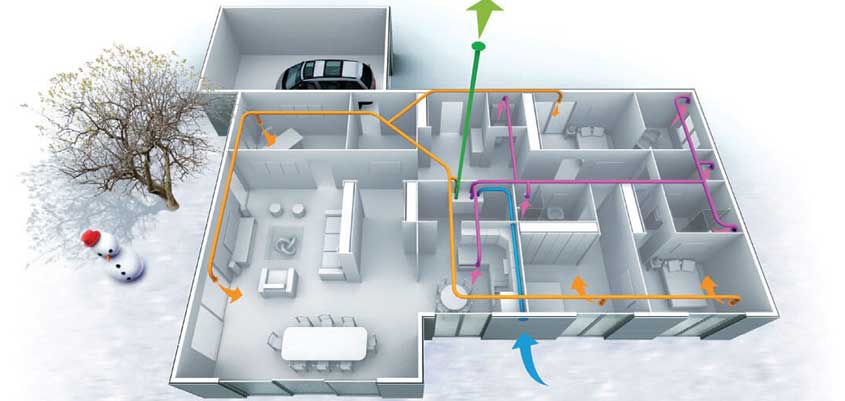
The functions of mechanical ventilation are diverse, but the main one is to achieve air renewal that ensures the safety of people indoors. It is essential first to differentiate between the different types of ventilation systems:
- Hybrid ventilation systems. It uses mechanical systems alongside natural air circulation methods. For example, intake can be done naturally while air in poor condition is mechanically extracted. In favorable conditions, the mechanical system does not operate and allows air renewal to occur naturally.
- Simple flow mechanical ventilation systems. In this case, the extraction of air is done mechanically at all times. We do not have to worry about it at any time, while air intake is done through entry grids that connect the outside with each room, since for proper functioning, the windows need to be closed.
- Mechanical double flow ventilation systems. These are the ones in which air intake and extraction are performed mechanically and automatically.
By using one of these systems, it is possible to limit the use of traditional heating and air conditioning systems. And even eliminate energy consumption in climatization for most situations at no cost. That is why double flow ventilation is very common in sustainable residential projects such as those registered in Passivhaus or the BREEAM certification label.
Efficient characteristics of double flow ventilation

The mechanical ventilation guarantees air circulation to improve our health, but energy efficiency in double flow ventilation is achieved by controlling the air introduced into the spaces, as well as extracting the air in poorer condition.
What are the main functions incorporated by double flow ventilation?
- Automatic analysis of the air situation at home. By using probes and sensors, the conditions inside each room are known. Temperature, humidity, and air quality are monitored to know the real air needs.
- Constant flow air intake. The introduction of air into the home occurs based on the specific situation at any moment. The flow rate of intake is adjusted according to what is needed at any given time.
- Clean and quality air. When introducing air, it is filtered before entering the home. The filtering will adapt to the pollution level in the air. Similarly, comfort is higher because it also prevents the entry of mosquitoes and other insects, as well as harmful particles and even bad odors, depending on the type of filter used.
- Extraction of air in poor condition. The system also adapts to indoor air quality to know how much needs to be extracted at all times. In this way, if there is smoke or remnants of cleaning products in the air, mechanical extraction will eliminate that air for greater quality. Even thanks to double flow ventilation, we ensure that windows never fog up again.
- Heating. This is one of the advantages of energy efficiency in double flow ventilation, as in winter it is possible to heat the air introduced from outside. The best way to do this is through a heat recovery unit, which can heat the outside air simply with the energy consumption of the fans. The air that is introduced arrives heated at the rooms.
- Cooling. Similarly, the air can be cooled when entering the rooms in summer, avoiding air conditioning consumption with the same system.
An example that indicates the importance of energy efficiency in double flow ventilation is that in energy mortgages -whose interest rates improve based on the sustainability of the building-, the highest discount can only be obtained if the residence has a mechanical double flow ventilation system.
Comfort and sustainability in double flow ventilation

According to the Technical Building Code, in its Basic Document HS3, all current buildings must have ventilation systems, as mentioned earlier, to guarantee healthiness indoors. Still, it is important to highlight that to maximize energy consumption, the best solution is double flow ventilation.
In addition to its health benefits, energy efficiency in double flow ventilation, comfort at home is also another aspect to highlight:
- A double flow system alongside a heat recovery unit is a comprehensive solution. Energy loads are never lost, and since the installation is done based on the needs of each building, there are no areas without mechanical ventilation.
- The location of double flow equipment can be arranged so it does not affect the comfort of the residence. For example, the heat recovery unit can be placed in an indoor and climate-controlled area to prevent it from being affected by outside temperatures, while the intake and extraction fans can be located in a non-habitable area, such as garages. This way, noise will not disturb at any time.
- Moreover, it is also more manageable by separating the different components of the ventilation system.
To maximize energy efficiency in double flow ventilation, a professional study is necessary to analyze the specific characteristics of each home or office building. However, it is a solution that, combined with good airtightness, ensures minimal energy consumption.

Siber Ventilation
Related posts

Constant flow ventilation systems, how do they work?

Discover which ventilation network best suits your project
Discover which ventilation network best suits your project Ventilation projects increasingly combine sustainability, comfort, health, and energy efficiency considerations. There is a clear objective to optimize resources. The aim is to advance along the lines of the Sustainable Development Goals (SDG 2030) and the philosophy passivhaus. Ventilation companies present projects compatible with energy efficiency and reduction of electricity consumption. This is contributed to by the overall context of crisis, with the resulting uncertainty arising from the invasion of Ukraine. Thus, for example, the government's energy security plan of Spain is a response to that reality.