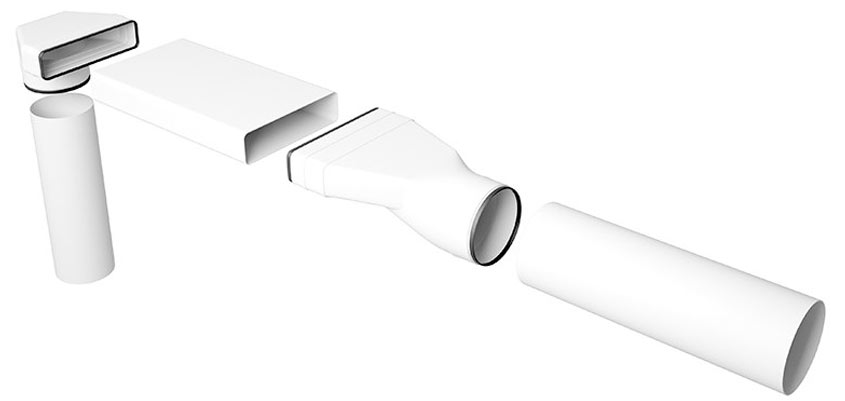
Ventilation ducts, how to improve their efficiency?

superadmin
February 4, 2019
The ventilation ducts are those that help us at home to distribute air among the various rooms. But the concept goes much further than that. It is not simply about ducts or vents through which air must enter or leave, since in mechanical ventilation systems -whether for domestic or industrial uses- the efficiency of the ventilation ducts will make us breathe better and also allow us to temper the outside air if we introduce it into our rooms.
What are mainly ventilation ducts? To understand it, it is necessary to contextualize that in current construction it is necessary to use mechanical ventilation systems to guarantee the correct airflow in interiors required by homes and workplaces. This is due to the fact that buildings are becoming more airtight, which means that air passage must be guaranteed. This is specified in the Technical Code of Building.
The ducts are the channels through which air will travel -driven by fans of the system itself-, and can be separated between those that are for extraction and those that work to introduce air into the rooms. Their design is very important, as depending on how they are, they will have a greater or lesser degree of efficiency. Some of the guidelines that should be followed in the ventilation ducts are:
- Ventilation flow. They must guarantee an adequate supply of air flow.
- Minimize the energy consumption of the fans. Depending on their design, the fans will have to exert greater or lesser force.
- Reduce the noise of the fans to avoid inconveniences to those residing in the rooms or to neighboring residents.
Load loss is the pressure that the air must exert to overcome friction within the duct. The greater the loss, the more energy the ventilation system will consume. However, the routing of the ducts is not perfect and, in many cases, it is necessary to make use of deviations, outlets, or the installation of elbows, which are curved paths. All of this offers resistance to the air, which through a good installation we must achieve to be as minimal as possible.
In search of greater efficiency of ventilation ducts
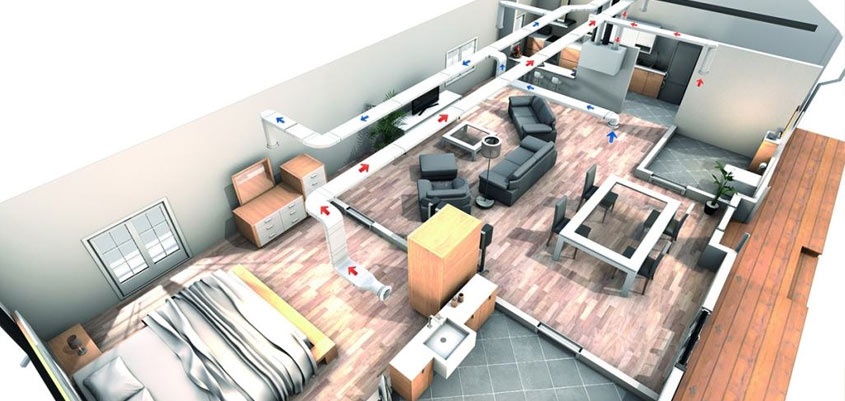
One of the maxims of the ventilation ducts is that they must be healthy and avoid discomfort. In double flow ventilation systems, outside air enters and is filtered before passing through the ducts to the rooms. That is why it is important for ducts to have anti-static and antibacterial properties. This way, up to 99% of bacteria can be eliminated in a ventilation network, as well as preventing the formation or accumulation of dust.
To improve the efficiency of ventilation ducts, other options include:
- Using maximum airtight joints to prevent air leaks that would mean increased flow.
- The duct network should not be oversized, as this would cause annoying sounds and greater energy consumption. The route of the ducts must be as short and as straight as possible.
- There are solutions for different parts of the ducts to anchor better together, with thermoplastic materials to prevent deterioration from humidity. It is important that the ducts are not affected by the elements.
- Diameter of the ducts. They can have different sections, being rectangular or circular in design normally. The diameter must be adjusted to the flow needs of the ventilation.
- Load losses. As we have mentioned, friction through the duct section causes the air to lose strength. We need to have the fewest load losses possible.
- Properties of the air. Temperature and pressure will influence the ventilation flow, so we must adjust to the climatic conditions of the location where the ventilation system is installed.

Siber Ventilation