




Acoustic pollution. Do you know how it affects our health?
Acoustic pollution
Noise or acoustic pollution has become one of the main threats to health in public spaces of large cities. Continued exposure to certain noise levels can affect not only our physical health but also our mental well-being. This is because half of the streets in large metropolises exceed the maximum noise level recommended by the World Health Organization (WHO) during the day.Decibels. The noise scale
In reality, the difference between sound and noise is not objective. It depends on how each individual perceives them. If we refer to the definition of sound, it would be the sensation received by the auditory organs when a variation in air pressure occurs. As a result of these variations, sound travels at 340 m/s (which is equivalent to 1,225 Km/h). When the variations range between 20 and 20,000 Hz, the sound is audible; that is, our ear is capable of perceiving it. The physical characteristics that define sound are:- Intensity: loud or weak; this marks the difference between sound and acoustic pollution.
- Pitch: high or low.
- Timber: depends on the harmonics and allows us to distinguish the sound of a guitar from that of a piano, for example.
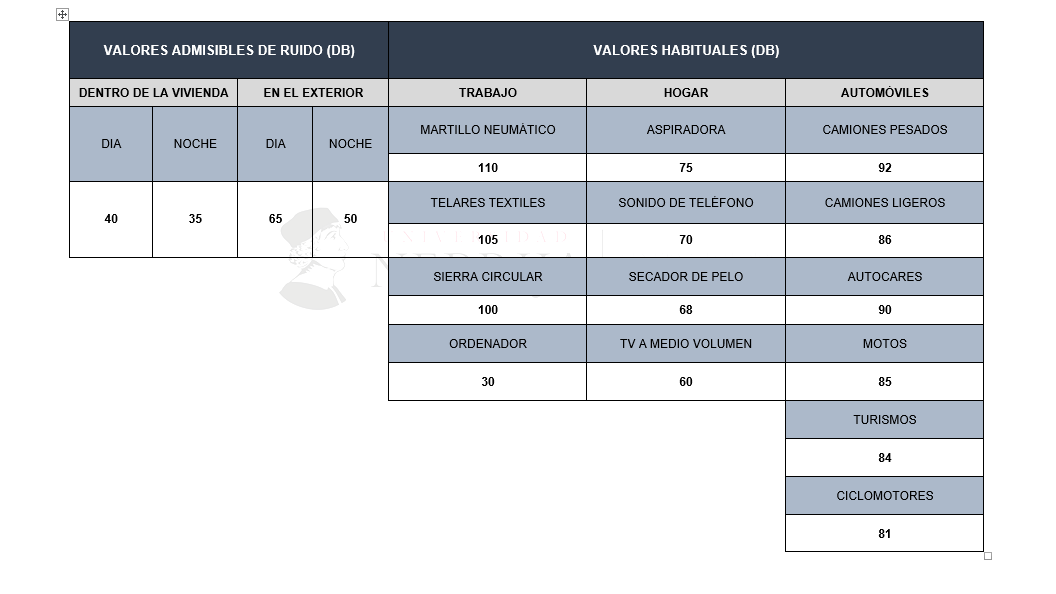
To measure a sound, it is necessary to measure its pressure. The most commonly used unit in acoustics is the Pascal. The human ear can detect 20 millionths of a Pascal (20 µPa) and can withstand a pressure 20 million times greater (20 Pa). However, when it comes to determining human perception of sound, the decibel scale is more appropriate as it allows establishing auditory levels, as reflected in the following table:
CTE.HR. Protection against noise
In this document, the Technical Code of Building defines the conditions under which buildings must be designed and constructed so that once they are in service, they are adequately protected against airborne noise, impact noise, or noise caused by their own installations. The code establishes these standards for any type of enclosure or building except for the following:- Enclosures that are noisy due to their usage characteristics, which will be governed by their own regulations.
- Public buildings such as auditoriums, music halls, theaters, or cinemas.
- Classrooms and conference rooms with a volume of less than 305 m³.
- Extensions, modifications, renovations, or rehabilitations of buildings, except for complete renovations.
- The rehabilitation of buildings categorized as cultural heritage.


Siber Ventilation
Manufacturer of High Energy Efficiency Ventilation Systems. Siber provides a set of high energy efficiency solutions in wind and mechanically intelligent ventilation, improving the Health, Hygiene, and Comfort of people, being respectful of the environment.
Related posts

CTE DB HS
CTE HS
CTE HR
Single-family housing and CTE requirements regarding ventilation
Current building regulations govern the ventilation and air conditioning system of your single-family home. Find out what these requirements are.