Why is humidity more noticeable in summer and on the coast?
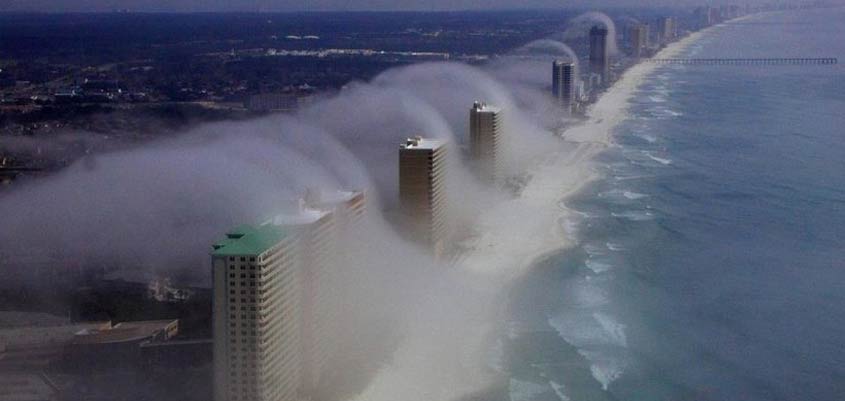
The photo above might seem like a natural disaster or a tsunami. But no. In reality, it is something more common that anyone living on the coast during these months knows very well. It is about humidity in summer, or when temperatures rise significantly in beach locations.
The tall buildings that appear to be flooded by waves of water belong to the city of Panama, which has a tropical climate, and the photo was taken in 2012. In reality, they are not waves of water, but gigantic humidity formations. The photos were taken from a helicopter because they were so surprising, but from the beach or the city, that effect was not visible.
In reality, the phenomenon was a large condensation of water vapor. When the moisture-laden air ascended to the top of the buildings, it cooled and condensed. Thus, those enormous waves were created.
The example goes beyond the graphic curiosity of what can create humidity in summer or in hot months in coastal locations. But it also gives us an image of what happens in beach places when temperatures rise.
 Why is there more humidity in summer in sunny beach areas? In warm months, not only do ambient temperatures rise. Thermometers also record increases in heat in the sea. This causes much more water to evaporate. And that volume of water vapor eventually reaches the air, thus converting into humidity. That is why there is more humidity on the beach in summer. Especially if there are no winds to carry the humidity away from the cities.
Increased sweating due to humidity in summer
In some areas, humidity is less noticeable, like in the Cantabric. This is due to the action of winds. But in Mediterranean regions, ambient humidity in summer is very high because the breeze is the dominant wind. What do we notice?- In summer and in coastal areas, with a high volume of humidity, we sweat much more.
- The nighttime temperature is similar to that of the rest of the day, despite the absence of sun.
- Staying indoors, if there are no ventilation systems or air conditioning units, is less pleasant, and the heat becomes more evident.
- On the other hand, temperatures in the sun are more moderate in inland areas, as humidity does not allow thermometers to spike. Even so, the thermal sensation is considered worse in humid areas.
But when there is a very high relative humidity in the environment, as occurs in coastal areas in summer, the air has a harder time accepting more vapor. This means that sweat does not evaporate easily from our body. The opposite occurs when relative humidity is low. In those cases, sweat evaporates quickly and does not stay on our skin.
That is why the thermal sensation is worse in a coastal area of Valencia at 30ºC, for example, than in an inland province at 36ºC.
The problem of humidity in summer goes much further. It can favor the appearance of dust mites and other bacteria, in addition to being a problem at home. Humidity is responsible for a number of health complications, and it is essential to control its effects at home.
As we have previously discussed, humidity in summer in coastal areas can make staying home much less pleasant due to excessive sweating and the elevated thermal sensation.
For this, the best solution is not an air conditioning unit. Although it can eliminate heat and provide a comfortable sensation, it does not renew the air or filter it. Moreover, the energy cost is very high, and when the air conditioning turns off, we suffer the humid heat of summer again.
A double flow mechanical ventilation system removes air that does not meet the necessary quality in interiors and automatically calculates if there is an excess of humidity in summer. In this way, it removes that moisture-laden air and renews it with filtered air, free of impurities. In the process, it manages to moderate the temperature in the house and make it comfortable, with almost no energy expenditure.


Siber Ventilation
Related posts