



What is an enthalpic recuperator used for and its differences
What is an enthalpic recuperator used for? It collects the sensible and latent energy of the air without transferring vapors or odors. Specifically, the word enthalpy, of Greek origin, means 'to add heat' and we use it to denote a thermodynamic magnitude symbolized by the letter H.
Types of heat recuperators
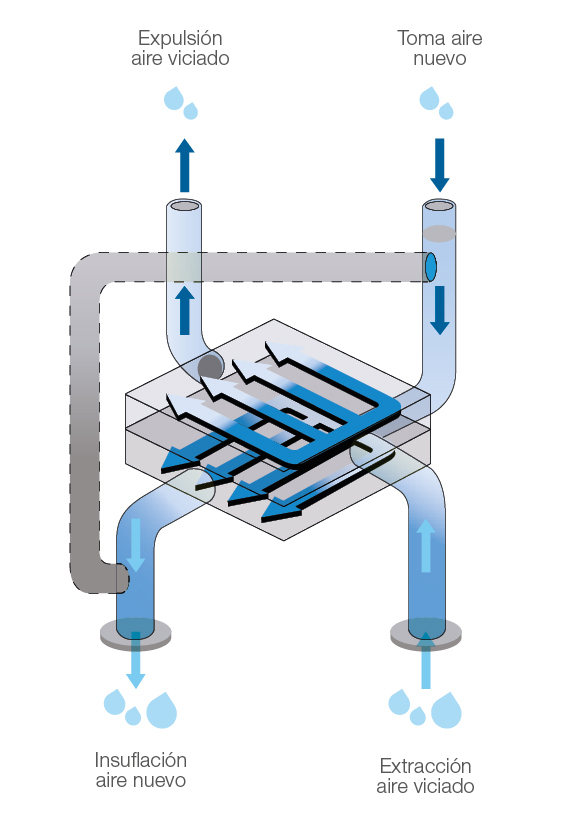
Heat recuperators are devices that contribute to thermal comfort and save energy. They achieve this during the ventilation process, in which they recover the air expelled from a room. They utilize the outgoing air temperature to balance that of the incoming air. This way, we consume less energy to heat or cool the air in a room.Therefore, this type of devices improves compared to traditional ventilation systems. Unlike these, recuperators use the indoor air that is expelled to heat or cool the incoming air. Thanks to this, the gas boiler operates with lower energy expenditure.
These are the types of heat recuperators, depending on their function, exchanger, and installation:
Function
- Thermal heat recuperator. Only recovers temperature (sensible heat).
- Enthalpic heat recuperator. Recovers temperature and humidity (sensible and latent heat).
Exchanger
- Cross-flow exchanger. Its efficiency varies between 50% and 70%. The airflow is orthogonal, while the heat exchange time is short.
- Parallel-flow exchanger. Efficiency circles around 90%. The reason is that the heat exchange takes place over a longer time.
- Rotary exchanger. Its efficiency varies between 70% and 85%. Part of the rotor is placed in the air return, while the other is in the supply.
Installation
- Centralized heat recuperator. A single device acts in several areas.
- Decentralized heat recuperator. Acts on a single room.

What is an enthalpic recuperator and what is it used for?
An enthalpic recuperator is installed in commercial premises, offices, homes, or recreational areas. However, its use is not recommended in healthcare facilities. The reason is that by transporting humidity, it can contribute to spreading bacteria in different areas.This type of recuperators helps us increase humidity levels in locations where it is very low, especially in cold climates. In this regard, enthalpy determines the thermodynamic potential of a gas. However, the amount of energy transported by the air largely depends on the water vapor content and the latent heat within it.
Its particularities and uses are:
- High thermal and latent efficiency. This is achieved thanks to its polymeric membrane.
- Interchangeable with conventional devices. It is easy to clean, replace, and repair.
- Antimicrobial technology. This type of devices is resistant to mold and bacteria.
- Blocks odors. In addition to avoiding bad smells, it eliminates extra air pollutants.
- Does not freeze. The membrane is tolerant to sub-zero temperatures.
- Domestic and commercial uses. It is used in homes, especially in areas with cold and low humidity climates. It is also used in shopping centers and workspaces. In areas with a warm and humid climate, it can be used to reduce humidity levels.
- Types. There are several, including those that have rotors and those that are passive mode.
In short, these controlled mechanical ventilation systems, such as the enthalpic recuperator, perform an air filtering function. Thanks to this process, we achieve more sustainable spaces with better air quality. Thus, they enhance health, hygiene, and comfort while respecting the environment. For those who find this post interesting, we recommend knowing the 5 valuable resources for the energy efficiency of our home.

Siber Ventilation
Related posts