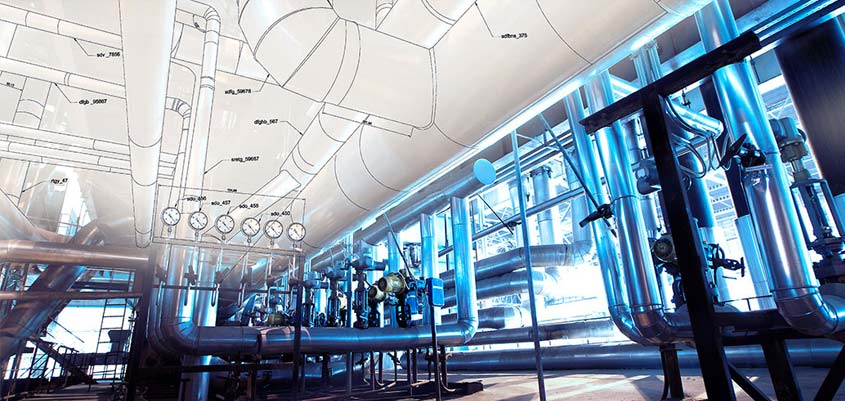
Ventilation in industrial buildings, regulations and design
If there are spaces where airing the rooms is even more difficult, those are undoubtedly professional environments. A fairly common case is industrial extractors in kitchens and in work areas without windows. And if we talk about a public place where special care must be taken, that is related to ventilating a parking lot, since the presence of smoke and other contaminants makes it a sensitive area. Nevertheless, ventilation in industrial buildings can be considered a greater challenge. Because it is in industrial environments where more contaminants can be produced.
While ventilation conflicts are very common in industrial settings, in many cases these installations are in poor condition or do not undergo the necessary reviews. Therefore, many industries have notable ventilation deficiencies, a problem that must be taken seriously to avoid serious issues with, for example, the health of workers.
Perhaps the main problem is that the regulations are not as clear as they could be. For ventilation in industrial buildings, what is considered essential is that the worker breathes in healthy conditions at their workstations.
The Decree Law regulating ventilation in industrial buildings is RD-427. It explains that a renewal of 30 m3/h per worker is necessary if there is no tobacco smoke. If there are problems due to smoke, whether from tobacco or from the production itself, the air renewal increases to 50 m3/h per worker. Obviously, we can already see in this regulatory situation that the Decree presents a certain antiquity by considering tobacco present indoors.
These are values that can easily be insufficient. Because this RD-427 only takes into account the renewal per person, without specifying anything about the size of the facility or the contamination capacity. And those standards can apply to small workshops or factories, with normal pedestrian traffic. But many industrial facilities may have thousands of square meters and only employ a handful of people. This is the case with oil refineries, for example. The existing regulation does not consider how to act in each specific case, and what is legal could be insufficient to ensure comfort at work.
What can we take into account if we have to address the ventilation of an industrial environment? Experts in these types of facilities provide a series of tips:
- The Decree RD-427 takes into account the number of times the air must be renewed each hour. It is better to consider the volume of the facility and its conditions.
- Thus, it is optimal to perform a number of renewals each hour based on the volume to be ventilated. The number of workers is also vital, but the size of the industrial area is more important.
How to implement ventilation in industrial buildings?
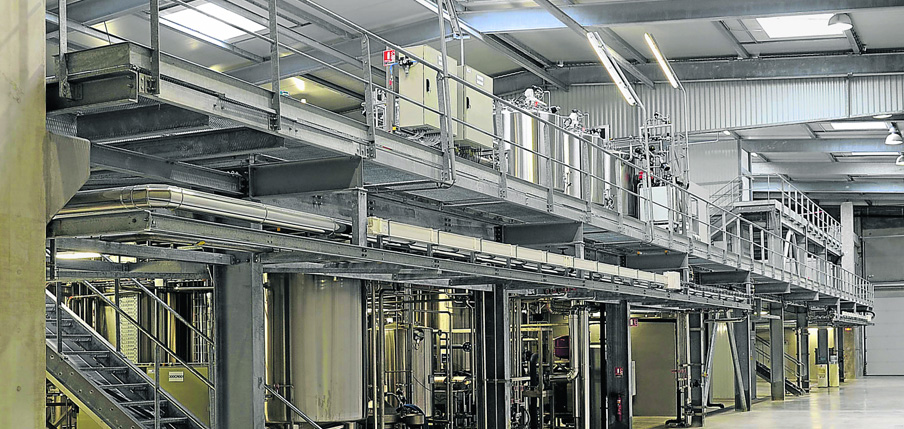
When designing an industrial building, ventilation must be an integral part of the complete design of the entire facility. It is essential to determine the necessary air flow and also the type of fans that may be useful for our installation. It is crucial to determine the areas from which air will be extracted and also those for the intake of fresh air.
In ventilation in industrial buildings, the use of helicoid extractors is common, many of them wall-mounted. They are noisier, but have lower pressure losses, which is important in industrial settings where air exchange is essential. For the intake of outside air, ventilation grilles are the most common.
If it is an industrial building without smoke and with common conditions, the most effective will be to use ventilation ducts that connect with all rooms. That is provided that the air has similar conditions in each area and there are no areas of higher contamination. For the installation of these systems, it is possible to use a centrifugal fan that can withstand the pressure losses well and does not have performance drops between the ducts.
If there are smoke sources in different rooms, in that case, smoke capture systems must be used that can be directed towards the sources of contamination. Ventilation in industrial buildings where there are many contaminants requires specific and customized solutions for each place. For example, in welding areas, we must consider that a peak of contamination occurs that must be eliminated. For this, there is industrial machinery designed to remove that smoke as efficiently as possible.

Siber Ventilation
Related posts

Air Purifiers: Functioning and Possibilities in Our Home
Bathroom fan to renew the air in humid rooms