Shunt and airflow in ventilation, how do they combine?
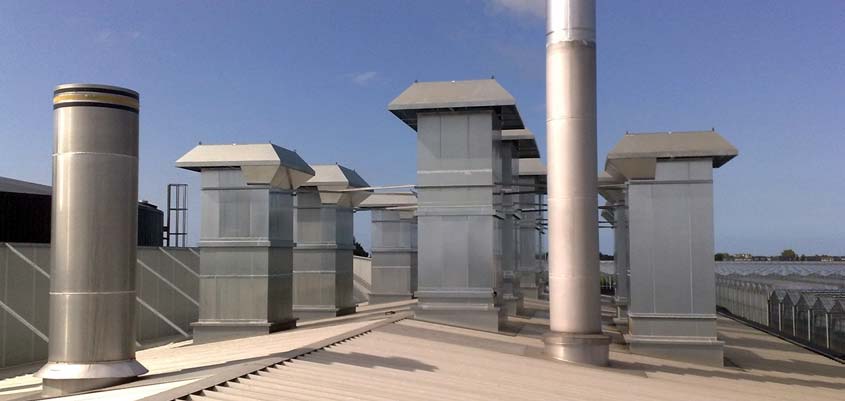
The shunt is a very important element in the development of a ventilation process, although it was something much more common in buildings prior to the Technical Building Code (CTE) and is typical in older buildings. We can define the ventilation shunt - also known as the ventilation shaft - as the large duct in buildings that splits into several smaller ducts that lead to each of the rooms, and whose functions were to evacuate smoke and create a passageway for air thanks to natural ventilation. This is why it is important to know how to combine shunt and airflow in order to ensure health standards in buildings.
Thanks to the shunt, multiple ducts could be interconnected without the risk that the renewed air came from another room. The air that enters through this network of ducts into a room is always from the outside; for example, air from a bathroom on another floor could never reach a bedroom. It was the most common form of natural ventilation until the Technical Building Code imposed other guidelines to ensure better indoor health standards.
Currently, the shunt could only be used if supported by a hybrid ventilation system that combines this way of renewing air with a mechanical system. But it cannot be the only mechanism for renewing air because the Basic Document HS3 specifies that to ensure necessary indoor health, all buildings must have a mechanical air renewal system.
So, what relationship do airflow and ventilation shunt have? Basically, in old buildings it is necessary to calculate whether the natural ventilation provides sufficient airflow through the shunt, depending on the number of rooms to ventilate.
The airflow in the shunt will not be stable, as it is natural ventilation. The local meteorology must be analyzed, although the data will have to be compared with the type of shunt and the different air passages. What result will the calculation of the shunt and airflow formula yield? Above all, the volume of people that can occupy each room. In any case, a high occupancy must be guaranteed.
How to correctly use shunt and airflow in ventilation?
As we have mentioned, the CTE currently does not include information about the exclusive use of shunt systems, although it may consider ventilation shafts in hybrid mechanical systems.Thus, the Basic Document HS3 on health collects this information in its article 3.2.3 on extraction ducts for hybrid ventilation.
- Each extraction duct must have a hybrid extractor located after the last extraction opening in the direction of airflow.
- The ducts must be vertical.
- If the ducts are collective, they must not serve more than 6 floors. The ducts for the last two floors must be individual.
What future do shunt systems have? Without a doubt, we must take them into account in rehabilitation and not in new construction, as it would not be necessary to install them based on the new CTE regulations. However, ventilation shunts can easily be adapted to older buildings that rely on this type of natural ventilation. It is possible to install hybrid ventilation systems at a low cost using the ventilation shafts.
Today, as the CTE warns, it is essential to guarantee a minimum ventilation airflow. And for that, a mechanical ventilation system or hybrid system is necessary. To achieve this, we can use the formula for calculating airflow:
Q= V x S
In this formula, V is the speed of the fluid passing through a section S. Following the units of the International Metric System, it is expressed in m/s and the airflow Q is expressed in m³/s.
Although today ventilation shafts are not commonly implemented in favor of the mechanical ventilation systems, they can still be reused in rehabilitation for implementing hybrid systems that combine shunt and airflow, thus meeting the regulations of the Technical Building Code.

Siber Ventilation
Related posts