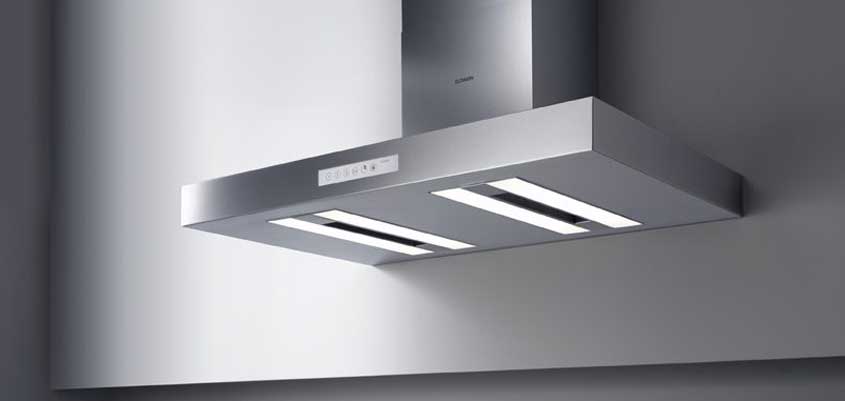
Range hood, how to choose the one your kitchen needs?
The excess of smoke, unpleasant odors, and also grease that gets into the air are common problems in the kitchen. Especially when we are preparing hot food on our stovetops. For this reason, there is the range hood, an appliance that is now essential in any home. It is the simplest and most efficient way to eliminate these unwanted side effects when preparing our favorite dishes.
However, not all range hoods are the same, and to choose the one that best suits our interests and also adapts better to our needs, we need to evaluate what each one is like. And first, the conditions of the place where it will be installed. Is it a closed kitchen or does it lead to the outside? Are the burners two electric stoves next to the wall or a gas hob in the middle of a space near a window that opens to the street? All of this will influence the type of hood we will need.
First of all, there are different designs of kitchen range hoods:
- Wall range hoods. These are the main ones, whether they are horizontal or angled towards the cooking area. They are usually attractive to look good in the kitchen.
- Island range hoods. These are designed for kitchens that are located in a space without walls. Very common in large kitchens of food lovers or even in culinary teaching places. They are suspended from the ceiling and made of stainless materials to be visually pleasing.
- Ultra-flat range hoods. These are enclosed in the wall or in a cabinet, and can even be removable. They can be stored, and the space they need is smaller. They are undoubtedly the most aesthetic.
Types of range hoods
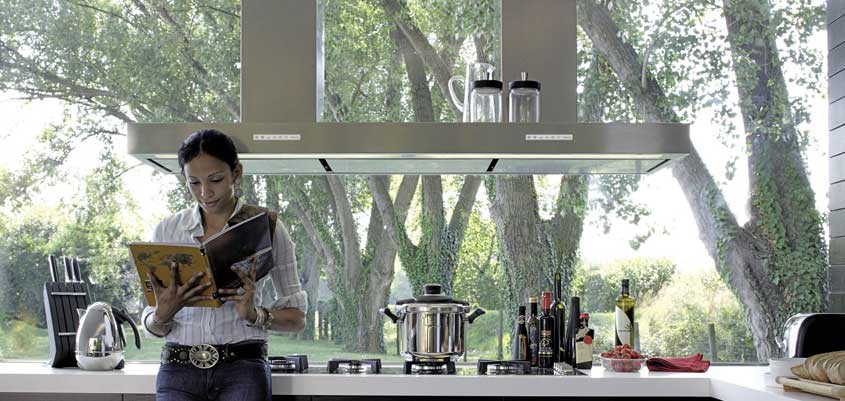
We have to consider the types of extraction that a range hood can have in our kitchens. We can find two predominant systems regarding what is done with the smoke and the rest of the impurities:
- Suction hoods: This is the most common extraction system. Most hoods for eliminating smoke and other unwanted materials in the kitchen also incorporate this. In this case, the motor acts as a vacuum on the air generated while cooking, which will pass through a filter in the hood that will eliminate the grease. The air and the smoke it contains will be sent outside the home. Ideally, the path the air has to take should be minimal, as this will make the motor work less and be more effective. The system itself has a mechanism to prevent smoke from returning. This type of range hood is considered the most effective as it completely eliminates smoke and the rest of the unwanted materials.
- Recirculating hoods: These also extract the air generated in our kitchen and are placed over the burners, but in this case, there is no exit to the outside for the air. Thus, what the hood does is first filter against grease and then eliminate odors and other residues. That same air, after being cleaned, is sent back to the kitchen.
- Size. The range hoods must at least match the size of the burners over which it will be placed. It will always be more effective, obviously, if it has a larger extraction space.
- Motor. The hood must have its motors shielded in iron to prevent grease from sticking. At least, it is interesting that it has at least two speeds, although it is common to find three power levels or even more.
- Noise. Historically, range hoods have always been quite noisy. However, in recent years this has changed a lot, and the noise tends to be absorbed better. At full power, a kitchen range hood usually generates about 80 decibels, which can already be loud. If it becomes bothersome, it's best to get one that doesn't exceed 50-60 decibels.
- Extraction. As we mentioned, the fewer tubes the range hood has, the better it will be to eliminate the smoke. If the motor is not very powerful, try to make the smoke's path to the outside as minimal as possible.

Siber Ventilation
Related posts