What is the formula for calculating the air renewal flow?
Requirements of the Technical Code regarding ventilation
The Technical Building Code in its Basic Document C.T.E.DB-HS. "Health", requires that within the rooms of a home, sufficient outdoor air flow be provided to ensure that in each of them, the annual average concentration of CO2 is less than 900 ppm and that the accumulated annual volume of CO2 exceeding 1,600 is less than 500,000 ppm.h.Additionally, the outdoor air flow provided must be sufficient to eliminate contaminants not directly related to human presence, such as Volatile Organic Compounds (V.O.C).
To meet these conditions, the Technical Code establishes minimum ventilation flows in the habitable areas of a home. In the case of an average-sized home, these values are:
- Main bedroom: 8 l/s.
- Other bedrooms: 4 l/s
- Dining room and living room: 8 l/s
- Storage rooms and common areas: 0.7 l/s per m2 of usable surface
- Parks and garages: 120 l/s per space
- Waste storage: 10 l/s
Mathematical formula for calculating air flow
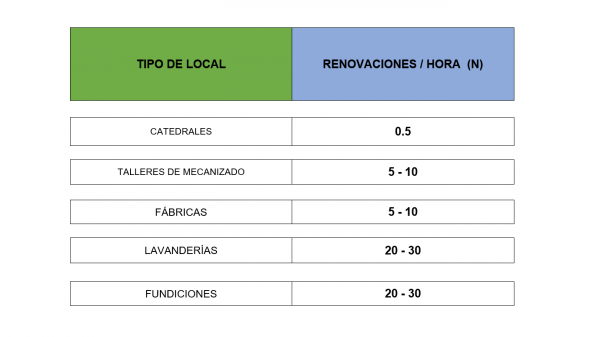
The general formula for calculating air flow is: Q= V x S where v is the velocity of the fluid passing through a section S. Following the units of the International System, it is expressed in m/s. Therefore, the flow Q is expressed in m³/s. Normally in the ventilation sector, it is more common to offer the flow in m3/h.Therefore, to determine the necessary flow, one must first know the air flow velocity and the section through which it will circulate. Of these two parameters, air velocity is the hardest to determine. For this reason, different velocity ranges are usually established beforehand, taking into account the use that will be given to the ventilation system. Air velocity is a very important parameter as it directly affects the noise produced by the air circulating through the ventilation ducts. Thus, in places where acoustic levels must be very controlled (hospitals, libraries, study rooms, etc.), the air flow velocity must be limited to a range of 4-6 m/s. Conversely, in systems that require the carrying of particles or other industrial processes, speeds exceeding 25 m/s can be reached. The following table provides indicative values of the air renewal volume required in certain buildings:


Siber Ventilation
Related posts

Why is mechanical ventilation necessary in homes?

Constant flow ventilation systems, how do they work?