Canadian well in ventilation, what does it offer us?
Ventilation is one of the main elements in the search for energy efficiency in our homes and in all buildings. Mechanical systems have revolutionized the way houses are ventilated and aired, and they have proven that it is possible to spend much less energy to achieve all the comfort we need. But there are also natural systems that can help to improve temperatures in our homes, such as ventilated roofs or chimney effect facades. And if we take advantage of the energy that lies underground, the option of the Canadian well appears, an alternative that makes simple use of geothermal energy.
The Canadian well is part of the trend in bioclimatic architecture, and its idea is to bring warm air into the house from outside even when it is very cold in winter, or vice versa: that in summer the air that comes from the street is cooler. An almost natural ventilation system that will not spend much on maintenance or supplies and that also has an affordable installation cost.
Its origin, obviously, comes from Canada, where it was used to improve temperatures in homes in its cold territory. Although it should be noted that there is the same trend in the Provence region of France, but to cool in summer. That is why the Canadian well is also called Provençal well. In any case, the same system serves for summer and winter.
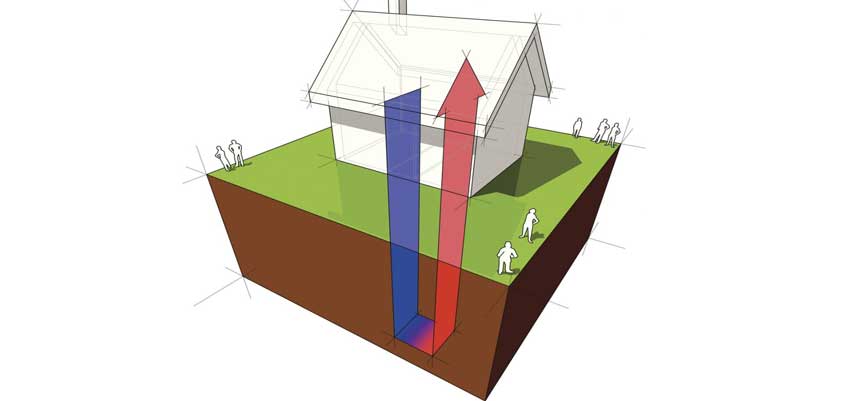
The operation of this technique that comes from geothermal energy is simple. The home is connected to the outside through ducts that must be buried underground. The depth is usually at least one and a half meters, and it is common not to exceed a depth of five meters. From there, air circulates among these ducts. The air inside will adapt to the temperature of the subsoil, which tends to be more or less constant, before entering the home. The system could be explained as follows:
- From a depth of two meters, it is understood that the temperature fluctuates much less and can be found in a range between 18 and 24 degrees.
- The system to temper the cold or warm air from the outside is that of a heat exchanger, which is natural, as it consists only of the tubes that connect the house with the outside air.
- The power of the Canadian or Provençal well system will depend on the installed ducts, the climatic and geographical situations, and the airtightness of the house.
- We have said before that it is almost natural, as it requires an air blower from the outside.
In not very hot summers, using this technology is usually sufficient to forget about air conditioning. While in winter the Canadian well will not be able to provide enough power, at least the need for air conditioning will be less.
It should also be taken into account that the Provençal or Canadian well does not extract air. To find a more efficient solution, the double flow ventilation system is a better alternative, as it extracts stale air and keeps the home always in the best ventilation conditions.
Factors to consider when installing a Canadian well
The Canadian well is truly simple in its operation, but professional intervention is necessary for its installation. In any case, it is better if it can be installed at the time the building is constructed rather than later. This significantly reduces installation costs.
Another characteristic to consider is that it must have at least a grate to prevent the entry of small rodents or insects into the home. An air filter is another option, better for preventing the entry of pollutants.
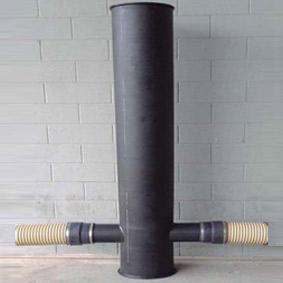
Regarding the ducts, they must be waterproof and also resistant to pressure and deformation of the ground. They cannot break inside the subsoil, as replacing them is really laborious. On the other hand, they must have high thermal conductivity so that the air can be tempered easily.
A drainage system must be installed that is efficient so that, when it rains, water is quickly eliminated from the ducts. In addition, the fan must be positioned so that it is not affected by weather conditions.
Another factor to consider is that in areas affected by radon gas this poison does not filter into homes.
In short, it is interesting to have the Canadian well in ventilation as an option to consider for homes where using this simple and ecological geothermal source is sufficient.

Siber Ventilation
Related posts

Why is mechanical ventilation necessary in homes?

Constant flow ventilation systems, how do they work?