Natural Ventilation: an Insufficient Ventilation Strategy

superadmin
May 30, 2017
Do you know the shortcomings of the traditional natural ventilation system compared to the advantages offered by a controlled mechanical double flow ventilation system? In this article, we explain the types of ventilation that exist and their relationship with energy efficiency and sustainability.
Types of Ventilation
To ensure quality air indoors, a minimum air flow rate must be provided, ensuring that fresh, clean air free of impurities is supplied while stale air is extracted from the interior. There are three ways to ventilate a room: natural ventilation, mechanical ventilation, and hybrid ventilation (the sum of the first two).Natural Ventilation
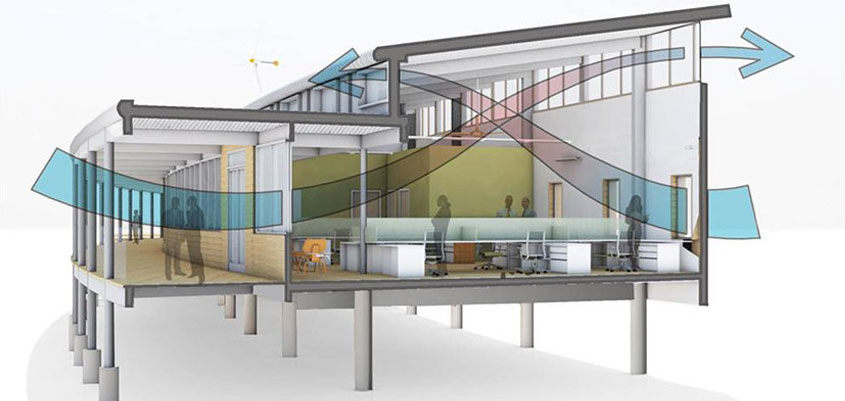
We talk about natural ventilation when no mechanical means are employed to extract or supply air. This is the type of ventilation traditionally used. There are three types of natural ventilation: unilateral natural and cross-unilateral natural (in both cases, horizontal regeneration), and natural thermal draft (through vertical ducts).In the first case, the air regeneration occurs through the openings of the building envelope due to differences in pressure and temperature. Thus, if the air pressure between the two sides of the envelope is different, a current is created from the room with higher pressure to the room with lower pressure. In the second case, also due to a difference in pressures, ventilation occurs due to the opposition between air intake and exhaust. Neither unilateral natural ventilation nor cross-unilateral natural ventilation guarantee a mold-free environment in spaces where relative humidity is high, as the act of ventilating is solely in the hands of the users, who, for various reasons, cannot keep the windows open as much as would be desirable and necessary.
The third case, natural ventilation by thermal draft, is based on the principle that hot air rises, as it weighs less than cold air. The difference in air densities, resulting from temperature and humidity differences, activates the vertical ducts (shunts). This third type of natural ventilation is also ineffective, as air currents do not occur if there is thermal inversion or if the existing outside air currents are insufficient to create the necessary suction effect. This contributes to the appearance of moisture stains and unpleasant odors.
Controlled Mechanical Double Flow Ventilation
This is undoubtedly the most efficient ventilation system. Thanks to heat recoverers, not only is comfort and well-being increased, but economic savings are achieved from the first bill. Heat recoverers are devices that exchange energy between the conditioned exhaust air and the supply air coming from outside. A controlled mechanical double flow ventilation system ensures that the air introduced into the indoor spaces is healthy and free of impurities and contaminants. Moreover, thanks to the existence of sensors that adapt the humidity of the supplied air to the humidity of the interior, indoor air is maintained within recommended parameters (between 50% and 60%), regardless of the humidity of the air outside.Ventilation and Regulations
Current regulations (CTE DB HS 3, Indoor Air Quality) do not consider natural ventilation as a general ventilation system, since this traditional ventilation system has proven to be inefficient. Thus, the CTE only stipulates hybrid ventilation and mechanical ventilation as the only possible systems to ensure indoor air quality that does not jeopardize people's health and guarantees maximum comfort and well-being for occupants.

Siber Ventilation