Hybrid or mechanical ventilation, which system to choose?
The mechanical ventilation systems are the future of indoor air renewal. More than an alternative, they are now a requirement in the Technical Building Code, as the sector has shown that to ensure health at home and the energy efficiency of buildings, it is necessary to use mechanical air renewal systems. The two main differences -and options in the market- lie in total use of fans at all times or alternating with naturally ventilating the spaces. What we call hybrid or mechanical ventilation. Which system best fits our needs?
It will largely depend on the type of building and its previous construction or the location where it is implemented. There are also cost constraints, either at the time of installation or during the use of the ventilation systems. First of all, we can check what the Basic Document HS3 of the CTE says to determine the current regulations.
According to the regulations, all buildings today must have a ventilation system. The choice is whether we want hybrid or mechanical ventilation. On the other hand, it is also specified that air must circulate throughout the home from dry areas to wet ones, through admission openings that must connect the rooms with the outside in dry areas. These areas are the living room, bedrooms, or lounges.
The basic differences between both systems are:
- Hybrid ventilation systems. Uses natural and mechanical air renewal systems. That means the installation will use natural ventilation whenever possible and, when the situation is not favorable, will use the fans to automatically renew the air.
- Mechanical ventilation systems. In the case of mechanical systems, ventilation never turns off. The fans adjust to the real needs of air renewal at all times and never stop ventilating. The extraction adapts to the real ventilation needs.
In natural ventilation, the pressure differences that move the air are lower than those required in a mechanical system. In this way, hybrid ventilation systems must generate minimal load loss for the air to be moved.
The load losses should be minimized through large sections of vertical ducts, without elbows or other elements that generate pressure losses. This is why hybrid systems require, in some cases, a much greater study of the conditions of each building as well.
Then, there is the influence of climatological factors on ventilation. For example, when the temperature difference between indoor and outdoor air is quite high, good natural ventilation occurs: the hot air has lower density and rises. If there is a lot of wind, the air renewal also improves naturally.
To carry out a hybrid ventilation installation, it is very necessary to comply with the minimum flow rates of the CTE, and in hybrid ventilation it can involve greater effort to adapt to climatic conditions.
When to choose between hybrid or mechanical ventilation?
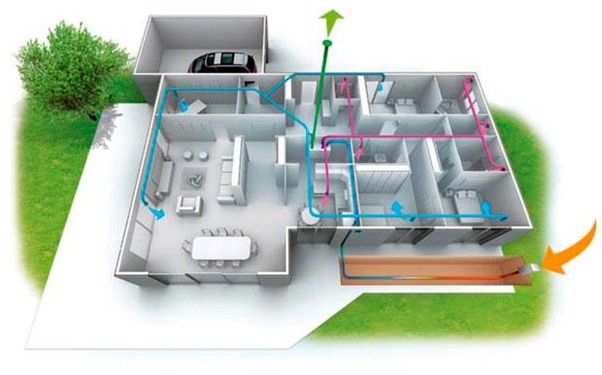
The mechanical ventilation is a better solution for new buildings, as ducts can be installed during the construction of homes or offices. Implemented comprehensively from the beginning of the building design, it is the most effective solution for improving the health of those who occupy the premises and also for ensuring proper energy efficiency in buildings.
For this, the double flow mechanical ventilation system is the best way to implement air renewal indoors:
- Health improves indoors by breathing clean, quality air. Whenever the air becomes polluted, it is extracted by the ventilation system and expelled outside the buildings, either due to generating stale air or by being contaminated with kitchen smoke. Through another duct network, outside air is introduced and filtered beforehand. By keeping the windows closed, the best air possible is breathed.
- Thanks to good thermal insulation, the double flow system is able to convert outdoor cold air into warm air in winter, and vice versa in summer, through a heat recovery unit.

Siber Ventilation
Related posts

Why is mechanical ventilation necessary in homes?