How to ventilate a parking lot and what we need to consider
The areas we allocate for parking require much greater air renewal needs than other spaces. Due to the extremely high contamination to which they are subjected, the care they require is much greater. Ventilating a parking lot is a task that not only needs to comply with regulations but also requires a lot of work.
Parking lots generate high levels of pollution due to the constant flow of vehicles in an enclosed space. They can become very dangerous spaces for people, which is why contamination must be extracted in the best way. Let’s not overlook that they are also exposed to the problems that vehicles can cause, such as fires.
The key in a parking lot is to evacuate pollution and gases that may cause combustion, to avoid precisely that fire risk. In addition, the construction of the parking must follow very strict regulations to be able to evacuate in case of problems. Regulations that generate many doubts among those who have to find a solution for the ventilation of a parking lot.
To ventilate a parking lot, one can opt for a mechanical ventilation system or a natural one, with the possibility of a mixed solution of both. Both methods will have to be governed by the ventilation regulations in parking lots, which contains a series of guidelines and obligations for each case. All of this is included in the Technical Building Code.
Ventilating a parking lot mechanically or naturally
The needs for ventilating a parking lot arise from the precaution to avoid the lack of oxygen that may occur due to the gases emitted by motor vehicles. Primarily, there are mechanical or natural ventilation systems, and it will depend on the needs of the place to choose one or the other.
Starting with natural ventilation systems, mixed openings must be available in two opposite areas of the façade. The distribution of air must be natural and the path free of obstacles, so that air can enter and exit effectively.
Means of mechanical ventilation are suitable for larger conditions and when the premises are closed, especially in underground areas. In these cases, the ventilation and the installed system must be for exclusive use of the parking lot. It can involve only the mechanical extraction of air, or both the action of removing air and introducing it.
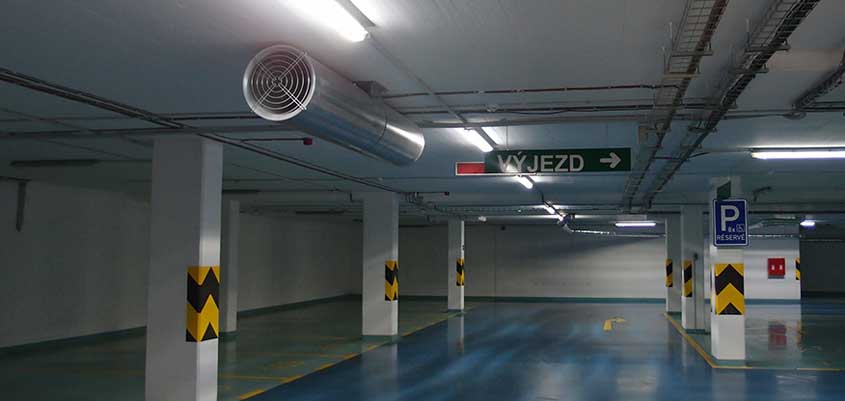
The ventilation openings must be respected according to what is stated in the regulations, as it must be ensured that there are no stagnations of contaminating gases. The ventilation systems installed must introduce fresh air from the outside and extract contaminated air from the parking lot. Traditional systems use ducts and fans, although recently tunnel methods, also known by the English term jet fans, are more popular.
This jet fans system can also be seen quite frequently in road tunnels. When it comes to ventilating a parking lot, it is a novelty compared to traditional systems. They can be complemented with traditional ventilation systems. Their operation is to generate an effect that distributes fresh air throughout the parking lot by creating sweeps in vertical movement in the areas to be ventilated.
It is a technological solution that allows for more efficient elimination of gases. It is, however, a system that is considerably more expensive to install, although it has subsequent savings in energy costs. They are also a good solution for parking lots with not very high ceilings.
In any case, the use of jet fans will greatly depend on the type of parking they are in. As we have said, it is possible to opt for natural ventilation systems or mechanical ones, depending on where the parking lot is located. Tunnel solutions are undoubtedly effective when it comes to underground areas without ventilation and very low ceilings, situations that require greater ventilation.
On the other hand, it must be kept in mind what to do in case of fire in a parking lot. It's important to remember that gases and pollutants that can combust are present at all times. In these cases, parking lots are places of greater risk because their access and exit are difficult to pass. Evacuating in case of danger is difficult if the parking lot is full.
Regardless of the system installed, it is essential to ensure optimal evacuation and that combustion products can be extracted as quickly as possible. Fires may occur and gases may also be harmful to people, including firefighters in case of a fire.
Ventilating a parking lot is an important task due to the risk that poor ventilation would pose to all users of the facility. Ideally, a study should be done to see if natural ventilation can be opted for or if investment in mechanical ventilation or advanced systems like jet fans is necessary.

Siber Ventilation
Related posts

Constant flow ventilation systems, how do they work?