Guide to Nearly Zero Energy Buildings (nZEB): towards energy efficiency
One of the most important days for the construction sector in Spain is about to arrive. From January 1, 2020, all works carried out in Spain must be Nearly Zero Energy Buildings (nZEB), which represents a significant advance in energy efficiency in our country, in addition to a new set of rules to follow in all buildings that are built or rehabilitated.
A few years ago, speaking of Nearly Zero Energy Buildings was very uncommon. Spanish builders only adhered to the existing regulations and did not consider the recommendations of the European Union, which has long requested that the construction sector focus more on energy efficiency. Because of this, the Technical Building Code has been adjusting for some time so that homes and workplaces consume the minimum amount of electricity or gas.
However, this type of construction -also known as Nearly Zero Energy Building (nZEB)- goes much further, and to some it still sounds like science fiction. How can it be possible for there to be constructions that do not consume electricity or that have an extremely reduced consumption? Well, before explaining this, the answer lies in European cities: there are already hundreds of buildings certified as nZEB (nearly Zero Energy Building in its English qualification) spread across the territory.
The rise of Nearly Zero Energy Buildings
We can say that Nearly Zero Energy Buildings is not something new, although it has only been recently discussed in the Spanish media. The definition of Nearly Zero Energy Buildings, with the English initials nZEB, comes from the European Directive 2010/31/EU introduced nearly a decade ago. With it, buildings were encouraged to achieve that nearly zero consumption, generally, through:- Buildings prepared to combat cold and heat with thermal insulation and ventilation systems instead of traditional air conditioning mechanisms.
- Implementation of systems that use renewable energy.
- Construction focused on saving energy and avoiding consumption, rather than minimizing investment.
In search of clear regulations for nZEB buildings
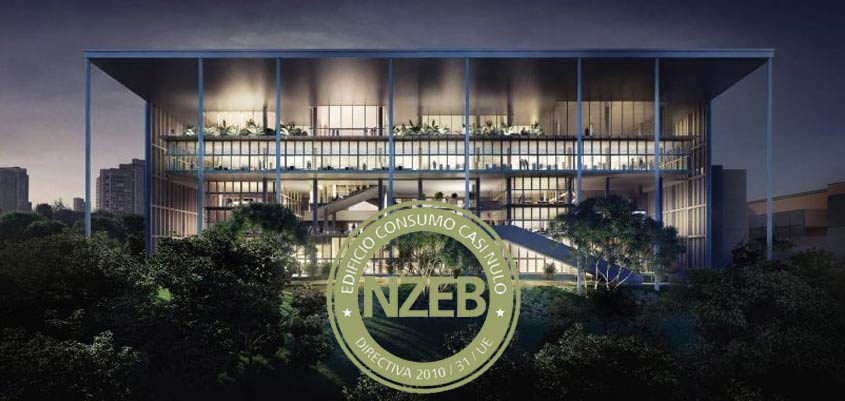
One of the key aspects of future nZEB construction is regulation, which continues to concern many builders and also a good number of architects. The problem is that, just a few months before Nearly Zero Energy Buildings become mandatory, the regulations are still somewhat vague and there is no text that specifies exactly what criteria must be followed.
This is because the European Union provides a series of recommendations and ideas, for example that a third of the total energy expenditure can be allocated to mechanical ventilation, which makes it possible for air conditioning to be supplemented by the installation of double-flow ventilation systems, which can replace heating and air conditioning equipment.
Among the different generalities specified by the European Union, we find the following:
- Sustainable and also controlled lighting. On one hand, there is the installation of low-energy LED bulbs, but this is just the tip of the iceberg. In the Nearly Zero Energy Building proposed by the European Union, a specific orientation is adopted to maximize natural lighting, so that the maximum amount of sunlight enters. The automatic systems must be capable of ensuring the entry of light at key moments of the day.
- Low-consumption air conditioning. No one doubts that, in a building, the highest energy consumption is due to air conditioning. Therefore, passive cooling should be promoted in summer and in winter it should benefit from an airtight construction, always following the necessary advice of thermal insulation. Heat and cold entry should be avoided through systems that do not consume energy. If the building is constructed in an energetically efficient manner, we can have ventilated roofs and other types of mechanisms that make the use of air conditioning or heating devices unnecessary. In most cases, it is possible to avoid using air conditioning systems -at least for most of the year- thanks to thermal insulation.
- Mechanical ventilation systems. As we have already said, one third of the energy consumption in nZEB will occur due to the use of ventilation, so we must consciously choose what type of system we will need. In this case, we can relate thermal insulation to the application it provides in terms of air conditioning through double-flow mechanical ventilation technology. This type of ventilation system may include a heat recovery unit, which can help us save on the electricity and gas bills, as in winter it heats the outside air that is pushed into the rooms, and in summer it cools it.
- Commitment to renewable energy sources. Similarly, a commitment must be made to sustainable energy from renewable sources. For example, it is a good alternative to have solar panels for the performance of air conditioning systems, and sanitary hot water systems (SHW) are also common, as we can eliminate energy consumption in heating water by collecting solar energy.
In Spain, this regulation is still not finalized. Although since 2018 all public work buildings must be nZEB, the reality is that the Technical Building Code is currently being applied, as the general Spanish regulations already consider many specificities in terms of energy efficiency.
One of the best ways to adapt to the future regulations of Nearly Zero Energy Buildings (nZEB) is to implement optional high energy efficiency certificates, such as BREEAM or Passivhaus. Through adapting to the regulations set out in these certificates, it is possible to achieve Nearly Zero Energy Buildings, as they go beyond the European regulations.
The Congress of Nearly Zero Energy Buildings, a forum to learn about nZEBs
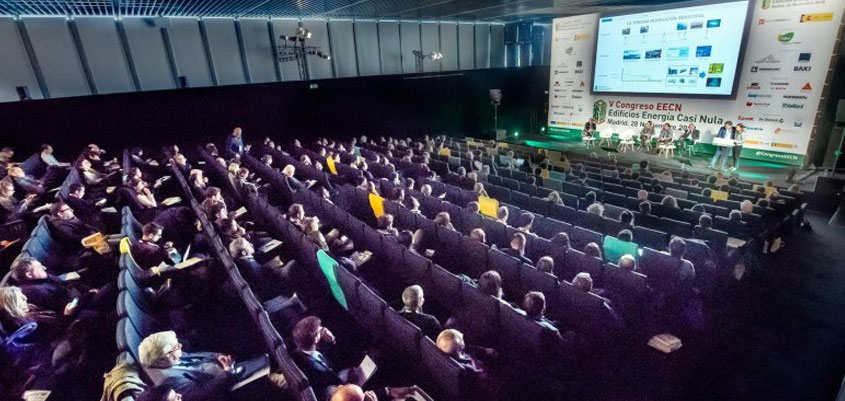
To promote knowledge about High-Efficiency Buildings, on October 23rd, the Nearly Zero Energy Buildings Congress (nZEB) was held, the main professional meeting forum to address the current state of this type of construction and what its implementation will mean for our country. This was the sixth edition of this congress and it was held at the La Nave Auditorium in Madrid.
The main slogan of this new edition of the most important forum on High-Efficiency Buildings is: And after nZEB, what? A vision of the future. This is an approach that aims to respond to the immediate future, both for new constructions and for rehabilitation projects.
This important forum for the construction sector is aimed at architects, engineers, builders, promoters, material manufacturers, representatives of the administration, energy sector companies, installers, property administrators, or universities, among other stakeholders. Here, the current legal and technical status can be known to achieve buildings that barely consume energy or learn from experiences and opinions about the most important projects carried out.
The Nearly Zero Energy Buildings Congress is not only the place to learn more about this type of construction through round tables and conferences, but also a place to connect with important personalities in the sector and professionals in nZEBs.
Siber Zone participated in the round table titled: Renovation and Nearly Zero Energy Building: an opportunity for the generation of economic, social, and environmental value, which was attended by our technician Siber Ventilation Alberto Rodríguez.
nZEB Congress
There is no doubt that the Nearly Zero Energy Buildings Congress is the most important event in the sector where to address what will mean High-Efficiency Buildings, making it the essential forum for the sector to learn about this. Topics discussed there included:- The most important projects and solutions of Nearly Zero Energy Buildings.
- The current legal status and the proposed regulations, as well as solutions to adapt to the imminent obligation.
- Meeting important personalities in the sector and networking.

Siber Ventilation
Related posts

Constant flow ventilation systems, how do they work?