Functioning of the Heat Recovery Unit
The dual flow ventilation technology with heat recovery has become the most efficient alternative to conventional systems. In fact, its advantages are undeniable in this regard. But what are they and how do they work? Two questions that we want to answer clearly and precisely.
What is a dual flow ventilation system with heat recovery?
Dual flow ventilation is a very curious technology. On one hand, it extracts stale air from the humid areas inside the house. We are referring, for example, to the kitchen and bathroom. On the other hand, it introduces fresh air from the outside into the space. This translates into a constant renewal of the air and a notable improvement in its quality.
However, the component that really makes a difference compared to other ventilation systems is the heat recovery unit. A very useful device, especially in homes that need to frequently use air conditioning systems both in winter and summer. Let’s see why.
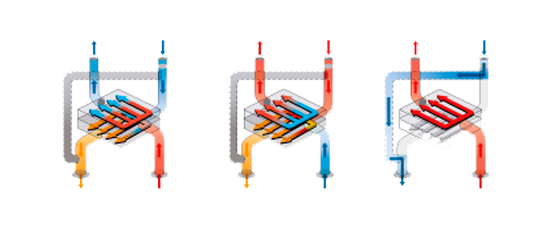
Devices that recover heat and cold air
Both the air intake duct and the exhaust duct of the ventilation system cross each other in this device. Inside, they exchange the heat they contain, although they do not mix at any time. The percentage of temperature transmission is around 80%.But what does this mean? Very simple. In winter, it is necessary to make a significant energy investment to heat the house through the heating system. The same happens in summer with the air conditioning. However, when ventilating the house, that heat could be completely lost.
That is when this device comes into play. Specifically, it is capable of recovering 80% of the heat or cold present in the air, meaning that to reach the previously achieved temperature thanks to the air conditioning system, only 20% more energy will need to be used. This undoubtedly makes it the most efficient and environmentally friendly option.
What advantages does the heat recovery unit offer in single-family homes compared to conventional systems?
Whether we talk about simply opening the windows of the property or using mechanical ventilation systems without heat recovery, the drawbacks in terms of energy efficiency are obvious. First, ensuring proper levels of air renewal consistently is not easy. Furthermore, they represent a great waste of air conditioning and heating.
On the other hand, they increase noise inside the property, and when external temperatures are extreme, they cannot be used for too long. To this, we must add the detrimental effect of pollution, especially in large cities.
A heat recovery unit in a single-family home solves all these problems in one fell swoop. Furthermore, it is increasingly common for it to include an air purifier inside. This element usually consists of a series of filters that trap pollen, dust mites, and polluting particles. An especially interesting feature for people suffering from allergies or chronic respiratory problems.
In short, the heat recovery unit is the element that allows dual flow air renewal technologies to achieve the highest levels of sustainability and energy efficiency. In fact, it offers the possibility of recovering up to 80% of the temperature achieved by the air conditioning system. Although it is becoming more common in homes, it is also positioning itself as one of the most interesting ventilation systems for offices and businesses.

Siber Ventilation
Related posts