Decentralized double-flow ventilation in rehabilitation
Rehabilitation is one of the major sectors of the construction industry, and one that was greatly emphasized in the past decade after the economic crisis exploded. However, after the economy has changed and real sustainability needs have emerged, building renovation has become energy rehabilitation. And, for this, one of the best solutions is decentralized double-flow ventilation, the best solution for improving indoor air quality, ensuring health, and also saving on utilities.
Why focus on energy rehabilitation and what does it mean? First of all, for the sustainability of our cities. According to the European Alliance of Companies for Energy Efficiency in Buildings (EuroACE), 84% of Spanish buildings consume more energy than they should. It is no coincidence that buildings are the largest polluters in cities, not traffic.
From 2020, all constructions carried out in Spain will be Nearly Zero Energy Buildings, an initiative that stems from a European directive that will require all new construction, public or private, to use sustainable solutions such as airtightness or mechanical ventilation. But that does not solve the problem of that 84% of homes in energy deficiency. To do this, it is necessary to achieve rehabilitation focused on resource saving and moderate consumption, beyond other factors.
Energy rehabilitation can focus on several aspects:
- Implement changes that help buildings protect themselves from the elements, such as ventilated facades and roofs.
- The windows and doors must be highly insulating.
- Install floating blinds and solutions on the roof against incoming sunlight.
- It is necessary to rehabilitate with materials that achieve airtightness and thermal insulation so that the weather does not penetrate.
- Light bulbs and lighting can be LED technology, and refrigerators and washing machines of maximum energy efficiency.
- Finally, the most important thing in many cases: a mechanical ventilation system is needed to ensure air flow.
- There is a duct dedicated to extracting the worst quality air from each room through fans, detecting the temperature, humidity, and air quality with probes and meters.
- Another duct is responsible for pushing air through fans from the outside, previously filtering the air to ensure it is of the best quality.
- There is a heat exchanger that can cool the air in summer and heat it in winter, without the expense of traditional air conditioning systems.
Advantages of decentralized double-flow ventilation
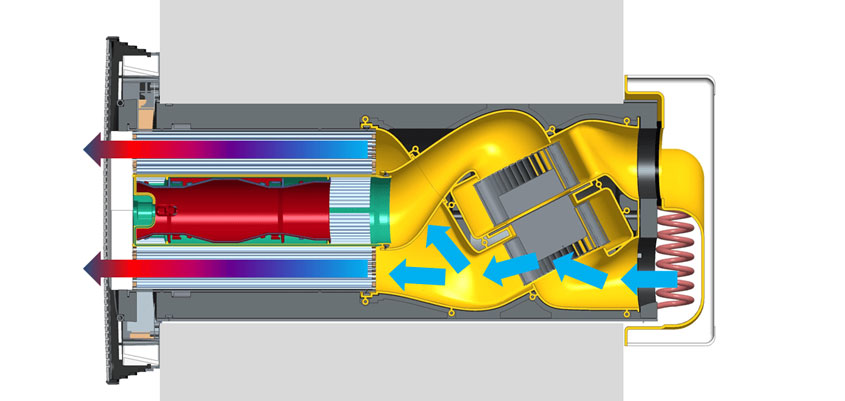
They are ideal for rehabilitation projects with little available space, as decentralized double-flow ventilation works by introducing and extracting air in a controlled manner in dry rooms, complementing with controlled extraction in wet rooms. The heat of the extracted air is recovered in the heat exchanger to warm the supplied air, making it a great option for energy efficiency.Some of the advantages of these systems are:
- Great air renewal space.
- One air intake for fresh air and another for expelling stale air.
- Ideal system for energy rehabilitation projects.
- Removable heat exchanger that facilitates maintenance.
- Low consumption motors to ensure energy efficiency.
- Exchanger with a recovery of up to 80%, greatly reducing the need for air conditioning.
- Simple installation for quick assembly and disassembly.
- Very quiet and discreet.
- Cools rooms at night thanks to the bypass.

Siber Ventilation
Related posts

Improve indoor air quality and adapt to current regulations

Energy service companies: what they are and what services they provide