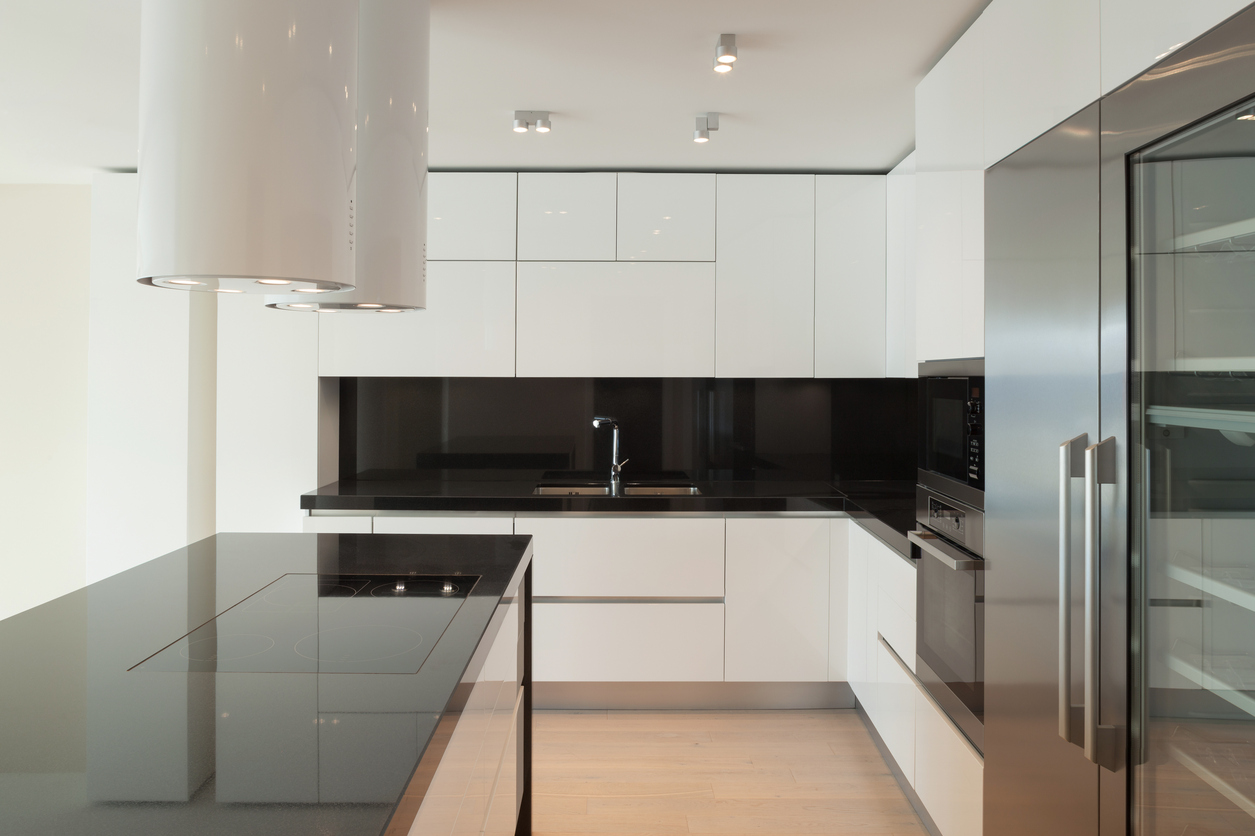
Range hoods, essential to ensure healthy air
To ensure healthy air in kitchens and proper extraction of cooking fumes, it is essential to have range hoods. There are numerous types and models available in the market (wall-mounted, island, ceiling, integrable into furniture…). Capable of adapting to the space and any style, the Technical Building Code, in its chapter HS 3 Indoor air quality, also reserves a space for them. The document establishes, in table 2.1 of that chapter, that the minimum required ventilation flow rate (qv) in the kitchen of a dwelling must be 2 l/s per m²/occupant. Similarly, it also requires additional ventilation for kitchens (range hoods) of 50 l/s.
What does the CTE DB HS3 say about range hoods?
The CTE DB HS3 stipulates that homes must have a general ventilation system (which can be mechanical or hybrid) that ensures proper air renewal. For this, air must circulate from dry areas (bedrooms, dining rooms, and living rooms) to wet ones (kitchens, bathrooms, and laundry rooms). Thus, there will be openings for admission in the former and openings for extraction in the latter.In the case of kitchens, the document states the following: "Kitchens must have an additional specific ventilation system with mechanical extraction for steam and cooking contaminants. For this, an extractor connected to an independent extraction duct from the general ventilation ducts of the dwelling must be available, which cannot be used for the extraction of air from other use premises. When this duct is shared by several extractors, each of them must be equipped with an automatic valve that keeps its connection with the duct open only when it is operating or any other backdraft prevention system."
Regarding the arrangement of the mentioned mechanical extractors, if the extraction duct for the ventilation of the range hoods of a multi-family building is collective, each extractor will connect to the collective duct through a branch below the next branch, to avoid the passage of odors between homes. Additionally, a grease and oil filter must be installed before the extractor, which incorporates a mechanism that indicates when the filter needs to be cleaned or replaced.
And what about the UNE EN 13779 standard?
The UNE EN 13779 Ventilation for non-residential buildings. Performance requirements for ventilation and conditioning systems of premises sets categories for the extracted air (extracted air) from the premises. These categories are employed regarding the air quality once it has been purified.The standard reminds us that the installation of range hoods must solve two fundamental issues. On the one hand, consideration must be given to the shape, design, size, and location of the hood. On the other, it must ensure the necessary ventilation flow for the extraction of cooking fumes and vapors, which can be expressed in m³/h or l/s. It must also be taken into account that the capture velocity (also called drag velocity) decreases with the square of the distance; that is, if the distance from the source of contamination doubles, the necessary flow must be quadrupled.


Siber Ventilation