The keys to the Passivhaus standard
In the last 15 years, we have seen how the demand for self-sufficient or low-consumption homes has increased, due to both the advancement of new technologies and the development of new materials, as well as the intention that has progressively permeated society to generate less pollution.
To tackle a passive house project, it is important to know the characteristics of the climate in which our project will be situated in order to adapt the materials used and the elements responsible for functions such as providing insulation or generating energy.
Due to the multiple environmental factors that affect the habitability and energy generation of a building, it would not be correct to apply the same strategies to preserve the thermal comfort of the interior of a home in the Canary Islands as to do so for a home in northern Europe.
What are we looking for in a Passivhaus?
The Passivhaus standard aims to minimize the heating and cooling needs of the building, relying on a series of strategies that we will address further on. The little energy needed to cover the reduced demand of the building can be easily obtained from renewable self-sufficient energy systems, such as photovoltaic panels.What are the practical strategies of a passive house or Passivhaus?
1. Correct thermal insulation:
We seek low thermal transmittance in walls, roofs, and floors, so we must ensure that the building envelope is correctly thermally insulated to avoid these transmittances both in winter and summer. In this case, the thickness of the insulation will vary according to the climate of the region.An example of good thermal insulation would be the Titania building in Madrid (DMDV Architects), where the entire envelope of the building has been insulated, including the foundation.
2. Suppression of thermal bridges:
Care in the construction at points of joint such as axes and joints is essential to avoid thermal bridges, points where we would lose or gain energy undesirably. The meeting of walls at complicated angles, or the joints between construction elements, are points where the surface temperature can be affected compared to the rest of the house. One of the unwanted results of the presence of thermal bridges is the appearance of mould.3. Openings:
Achieving a good thermal envelope is not everything, as there is a large area of it that remains exposed to the outside through doors, windows, skylights, etc. When we refer to openings, we talk about both glass and the carpentry that holds it. The carpentry must have high insulation values. For our climate, a glass is used that consists of two air chambers and three panes. To increase its insulation, one of the air chambers can be filled with Argon while placing insulating films on glass to counteract undesired heat or cold losses or gains.4. Mechanical ventilation:
Regarding energy conservation, we realize that many agents participate in energy generation within a home, such as tenants or appliances, energy that until recently was wasted.Mechanical ventilation proposes to integrate a device in the building that functions as a ventilation unit and has two objectives: the first is to force the extraction of air to renew it and thus ensure the quality of the indoor air; the second, through the heat recovery unit, minimize climatic changes inside by renewing the air.
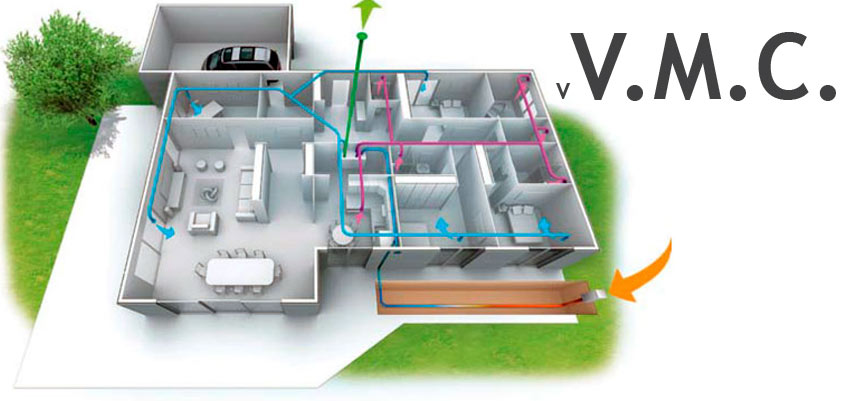
Heat recovery units operate through a extraction fan (draws air into the inside of the device) a supply fan (expels air to the outside of the device) and a heat exchanger, through which hot air releases heat to the colder air.
The correct application of these tips will allow our building to minimize its dependence on heating or cooling systems, thus ensuring good air quality for its users and a commitment to the environment, which is increasingly necessary.
5. Airtightness
The airtightness of the building envelope is responsible for maintaining stable climatic conditions and preventing imbalances due to temperature changes and drafts from the outside.To achieve this airtightness, special care must be taken at the most exposed points to the outside. When windows and doors do not have adequate sealing, energy losses can occur.
To measure airtightness, the so-called Blower Door test is used, which consists of producing a pressure difference between inside and outside through a fan placed in the main door. To meet the standard, the result must be less than 0.6 air changes per hour at a pressure differential of 50 Pa.


Siber Ventilation
Related posts