Learn to measure the necessary humidity at home
The humidity at home is one of the most common problems we face indoors, and it is necessary to combat this plague. The humidity can affect buildings and, even worse, the health of people. Controlling this issue is important, so measuring humidity is essential if you notice strange odors in your home or think there is too much water vapor in the air.
To understand how this problem affects us, we must understand what relative humidity is. It is the percentage of the amount of vapor contained in the air at a specific temperature. Similarly, we must consider what the dew point is: the temperature at which vapor could condense into dew.
To measure humidity, we must take into account that it is complicated if not done with appropriate equipment. Nevertheless, for a first approximation, we can always use simple tricks or homemade meters.
 Humidity also affects how we feel heat, and not for the better. The more humidity there is in the environment, the greater the sensation of heat, and with less humidity, we will feel cooler. If we sweat more with humidity, it’s because our body cannot eliminate it easily through our skin.
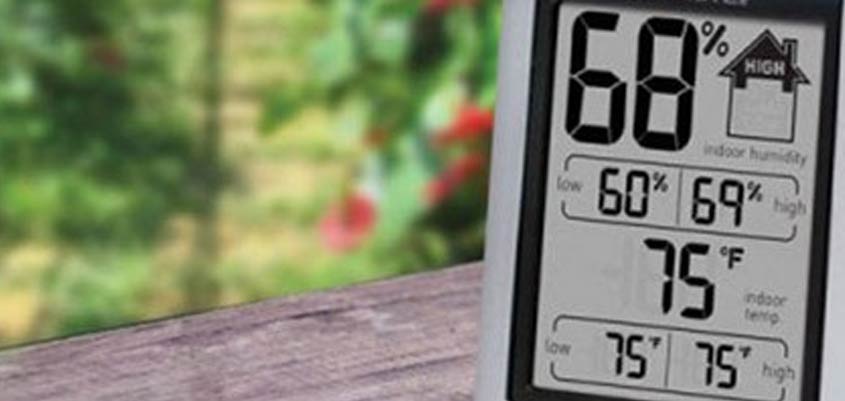
What humidity would be considered high? From 55% it will be considered that there is a problem, and we will notice it, although less than 25% also causes discomfort. In Spain, the problems with humidity usually arise from elevated levels and not from a lack of vapor in the air. Additionally, if we control the levels of humidity in a comfortable manner, we will also eliminate bacteria, viruses, and fungi.
The most efficient way to measure humidity is by using a hygrometer, which is the device that calculates the percentage of water vapor in the air, either outdoors or indoors. There are predominantly two types:
- Analog hygrometers. They have a material sensitive to humidity and are similar to traditional thermometers, with the difference of having a dial like an analog clock where humidity values are marked. They are cheap and easy to use, although they have a 10% margin of error up or down.
- Digital hygrometers. They determine relative humidity with an electric sensor that is affected by humidity. The simplest ones are only for indoors, and they have the advantage of being more specific than analog ones. Their LCD screen displays the humidity values and they have no more margin of error than 5% up or down.
- Look for a specific place. Humidity depends on temperature, so you should find an area of your house that is not affected by it. So avoid placing it near heat sources and especially near places where air conditioning units are in operation.
- Close the windows and doors and keep the hygrometer away from them. You need to avoid temperature fluctuations.
- Let it operate for a few hours and do not stick to the initial reading. Take three readings at different times, and then take an average of the obtained results. This will be the most effective way to get a truly representative value.
- Hygrometers need calibration. You can take it to a specialized store after some time or you can do it yourself. Place it outdoors and see if the value obtained matches the one given by the meteorology for that moment and adjust it.
The dew point when measuring humidity
To know the dew point in our home - as we said, the temperature at which vapor could condense into dew - you can do it simply.Fill a shiny metal bucket with water to reflect light and heat. Fill two-thirds of the bucket with water, and then start adding ice cubes progressively. Stir the contents until condensation forms on the surface of the bucket while continuing to add cubes.
There will come a moment when you will see water condensing on the walls of the bucket, which is called dew.
Then place a thermometer in the water, and you will have the dew point. This will tell us the temperature at which water completely saturates the air and at which water vapor condenses. What is that useful for? Basically, the higher the temperature recorded on the thermometer, the more we will feel the effects of humidity, and above all, the way it will affect us.
Both methods help us to measure humidity and see if we may have any problems due to excess in our homes.


Siber Ventilation
Related posts

Why is mechanical ventilation necessary in homes?