The European ErP (Energy Related Products) Directive and its impact on ventilation systems
The ventilation systems have been affected by the European ErP (Energy Related Products) Directive. This regulation has been in existence since 2009 and deals with what is known as ecodesign. Its aim is to minimize the environmental impact of products, which includes mechanical ventilation systems. To achieve this, it establishes a series of ecological design requirements. They apply to all types of devices. Among them are those used in systems to filter, supply, and extract air from indoor spaces.
The European ErP (Energy Related Products) Directive
This regulation applies in all member countries of the European Union and affects ventilation systems. It aims to improve the energy efficiency of devices sold in the EU territory. In this way, it seeks sustainability, as well as the protection of the environment. The fight against climate change is another of its aims.This European directive has two areas related to ventilation systems:
- Ecodesign. Directive 2009/125/EC, which imposes minimum energy performance values that devices must achieve. The ecodesign regulation related to ventilation units (no. 1253/2014) sets the energy performance requirements that apply to products launched by manufacturers from January 1, 2016. These requirements were strengthened on January 1, 2018.
- Energy labeling. Directive 2010/30/EU, to encourage the purchase of more efficient products by valuing the energy class of the device (A being better than G). The energy labeling regulation (no. 1254/2014) only applies to ventilation units intended for the residential market.
Its relation to ventilation systems
This directive includes requirements regarding:- Residential ventilation units.
- Ventilation units for collective installation.
However, there are many others, such as the following:
- LWA: sound power level of units without ducts.
- Multispeed or variable speed motor.
- By-pass in heat exchangers.
- Visual warning signal for changing air filters.
- Use of the unit (residential, non-residential), type of motor (multispeed or variable speed).
- Type of heat recovery unit.
- Thermal efficiency.
- Nominal flow, electrical power, pressure at nominal flow.
- Pressure drops of internal ventilation components.
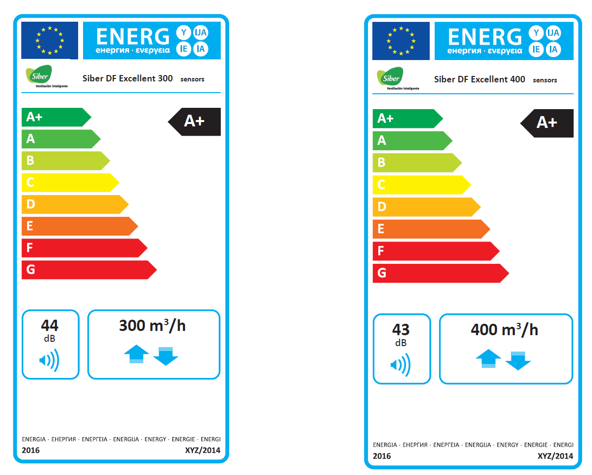
- Use of the unit (residential, non-residential), type of motor (multispeed or variable speed).
- Type of heat recovery unit.
- Thermal efficiency.
- Maximum flow and maximum electrical power.
- Reference flow and pressure.
- Acoustic power level.
- SEC value and energy class.
Ecodesign
This European regulation implies certain ecodesign requirements. If these are not met, systems do not obtain the CE mark certification, which prevents their circulation in the European market. Each device must meet certain characteristics and have a technical data sheet. It must reflect the criteria that are met for its authorization and marketing.Therefore, when proceeding with the installation of ventilation systems it is necessary to take into account the requirements of this regulation. In this way, proper air flow renewal in indoor spaces is guaranteed. If you wish to know more about ventilation systems, here is this article: First Passivhaus home in the Community of Madrid: success story.

Siber Ventilation
Related posts