Wind energy at home, is it really effective?
In Spain, wind energy has become a benchmark within the range of renewables. The climate and topography of our country are ideal for producing electricity thanks to the action of windmills. It is undoubtedly the most widespread renewable source in Spain, as more than 20% of the country's total demand is generated by windmills. However, it is not something so common in households. While solar thermal and photovoltaic energy are much more common, it is not as usual to find wind energy solutions in homes.
In reality, we can have energy solutions that use wind to provide electricity within our homes, but they are certainly not common. However, with small accumulators, it is possible to use the energy produced by a windmill turning on windy days.
It must be taken into account, however, that wind energy cannot be stored, which means it is only usable when the accumulator is working due to friction. Thus, on very windy days, we can use that wind to supply electricity to our home, but we will not store that energy. That is the main problem of wind renewable sources.
To have wind energy in our homes, it is essential that where the turbine is installed, there is a good wind resource. But in addition to that, it is necessary to consider the noise that the wind installation may generate, which can be quite bothersome to those nearby. For that reason, it is recommended to have ample land to be able to locate the windmill away from the areas where people spend most of their time.
As we said, having a wind energy system at home nearby can be quite bothersome, but it can also be an alternative to consider. When? Especially in those more isolated places, where it is not easy to receive electricity in the usual way or where power outages may occur.
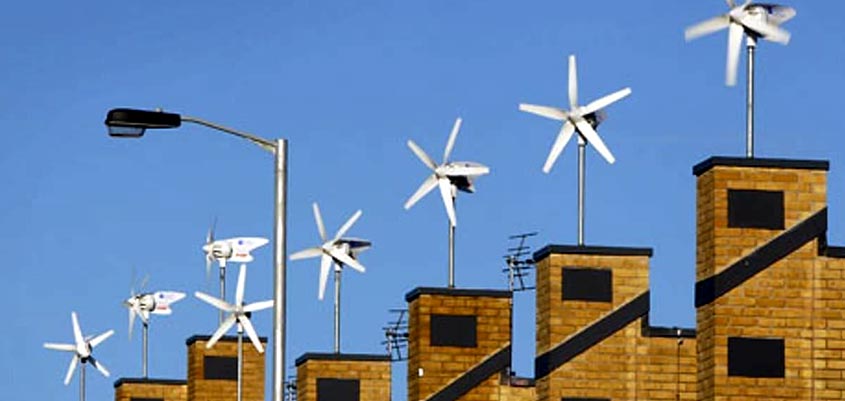
Typically, domestic solutions tend to be a mini wind turbine, which can have a power of up to 100 kilowatts (kW) and would utilize wind in the same manner that photovoltaic energy uses sunlight. With such a solution, it would be possible to supply a good part of the electricity of a home and, in situations of strong winds, meet all the demand.
While in Europe many households have mini wind solutions for electricity supply, in Spain it is not common and there is also no official registry. According to estimates from the World Wind Energy Association, about seven megawatts (MW) are generated, and there could be only around 10,000 installations throughout Spain.
These domestic wind energy installations are usually found in very isolated environments and rural areas. They are also installed in farms and rural houses or hostels, and some of them are illegal and not regulated. The most common is to install turbines of between 3 and 5 kW in grid-connected environments and with a distributed generation system for several users.
Why is wind energy not popular in homes?
As we have noted, wind energy is the most important renewable source in volume within our country. But at a domestic level, it is one of the least exploited. The main reason perhaps lies in the necessary installation, which requires an investment of up to 10,000 euros, which normally would not be considered unless it was mandated by regulation.
Even so, many experts believe that this is not the only explanation. For example, there is the fact that the technology used at the global production level has not been leveraged for the domestic market, so costs remain high. While solar panels have an affordable price, mini wind turbines do not. But this is not the only factor working against it.
Solar panels will always be silent, but mini wind turbines can generate noise. Additionally, in urban environments, wind energy solutions have not performed well. Likewise, there is no good manual on how to install wind turbines, and very poor results have been noted when installed incorrectly or in places where it is not possible to benefit from the wind.
What could be the solution for it to start becoming more popular? Without a doubt, wind associations point to regulatory changes in the sector. Although it is completely legal to install a wind self-consumption system at home, there is also a very unfavorable draft Royal Decree regarding self-consumption, which speaks of disproportionate fines. This causes distrust among those who fear that in the near future the use will be limited. Additionally, it is said that some electricity producers might promote regulations to prohibit wind energy in homes in order to not lose profits.

Siber Ventilation
Related posts

Constant flow ventilation systems, how do they work?