Forced ventilation in homes, types of mechanical systems
The need to ventilate a home or building leads us to choose a mechanism for air renewal indoors. Nowadays, it’s not enough to just open the windows; air doesn’t filter through walls or doors as it used to. So, do we choose between natural ventilation or forced ventilation? The former uses natural resources, while forced ventilation employs mechanical mechanisms that allow for greater control of air renewal.
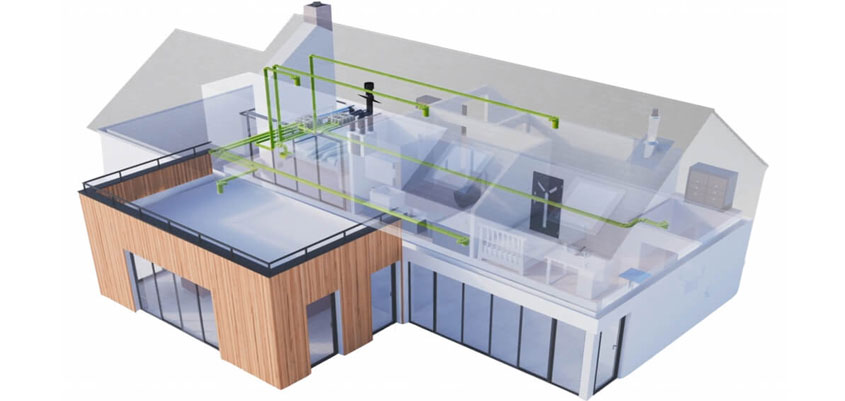
What do we understand by forced ventilation? Essentially, it is what we also call mechanical ventilation. It involves pushing air from the outside into a home or extracting it when its quality is insufficient or has been contaminated. The most comprehensive option is the one capable of extracting the stale air while introducing filtered air, known as double flow ventilation.
There are two main types of forced ventilation for air renewal indoors:
- The admission of air occurs naturally, through ventilation grilles connecting to the outside. While air enters the home through these grilles, contaminated air or smoke is extracted mechanically.
- The second option, known as double flow, is capable of regulating the flow of incoming and outgoing air completely.
In contrast, forced ventilation is capable of independently introducing and expelling the required air from each room, regardless of meteorological conditions, whether indoors or outdoors. Thus, this type of ventilation is the only one capable of guaranteeing the air quality needed indoors.
In mechanical ventilation systems, the airflow is ensured by fans that expel or introduce air using electrical energy. As a result, the necessary ventilation flow can be achieved, expressed in m³/s under the formula Q=Sv. In this case, S is the section, whose dimensions are expressed in m², and the velocity is applied in m/s.
The flow must be sufficient to guarantee the necessary airflow without causing a detriment to those inhabiting the rooms, either in terms of energy consumption or high noise levels.
The popularization of forced ventilation systems arises from the need to breathe better quality air indoors, a reality that is also echoed in regulations. The Basic Document HS3 of the Technical Code of Building speaks of the obligation to install a ventilation system that at least includes some mechanical functions. While in the past, indoor air quality was not taken into account, to improve our indoor health, we cannot ignore this aspect.
Types of forced ventilation systems
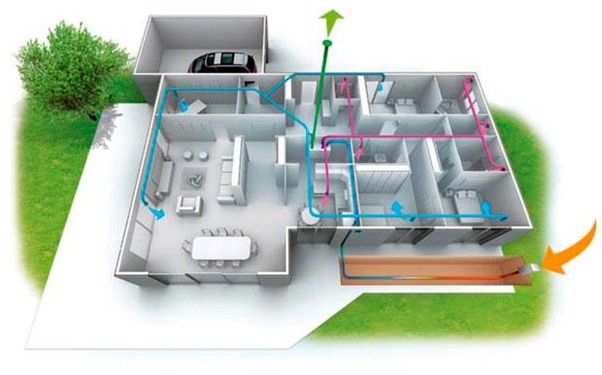
There are different types of forced ventilation systems, although all of them incorporate fans in some segment for air extraction or emission. To complement them, temperature, humidity, pollution, or presence probes are usually used.
The main types of forced ventilation are:
- Hybrid ventilation systems. They incorporate some type of natural ventilation. They are ideal for renovations of old buildings and also in areas where there are favorable weather conditions for ventilation. They will use natural mechanisms, and when that is not sufficient, will extract contaminated air mechanically.
- Simple flow mechanical ventilation systems. The introduction of air is made through ventilation grilles that connect to the interior. Such air intakes are in the dry areas of the buildings, such as living rooms or bedrooms. Extraction is done mechanically from the humid areas, such as kitchens or bathrooms.
- Double flow mechanical ventilation systems. They are the most advanced and highest quality option. They introduce the necessary air at any given moment, with filtered air of the highest quality before reaching the rooms. In the same way, they extract poorer quality or contaminated air.
Forced ventilation systems are the best solution to ensure comfort in the home and health, in addition to responding to the energy efficiency that is so necessary today.

Siber Ventilation
Related posts

Why is mechanical ventilation necessary in homes?

Constant flow ventilation systems, how do they work?