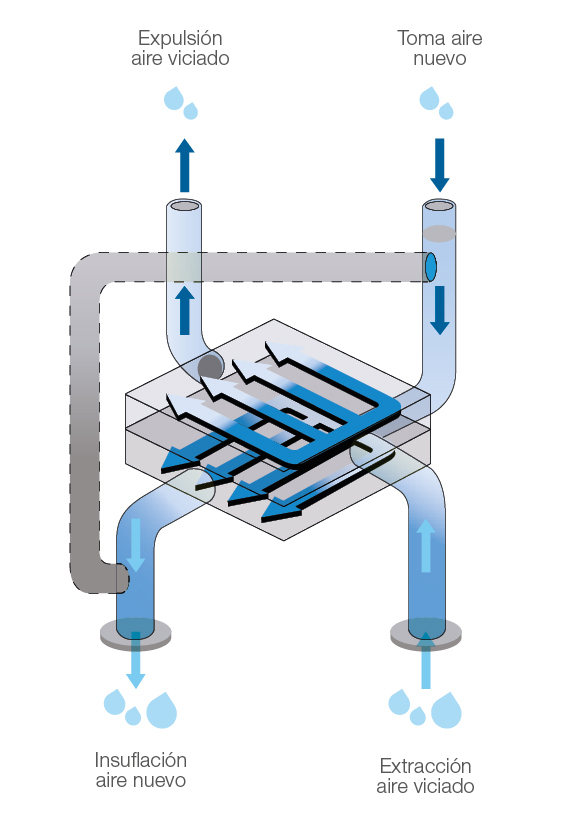
The enthalpic recoverer within the ventilation system
An energy recoverer is an essential element of ventilation equipment, as it reduces the energy demand of the system. This energy reduction is determined by the regulations themselves. At the national level, energy recovery is regulated in the Regulations for Thermal Installations in Buildings (RITE). As expressed in the document, there are two types of recoverers: heat recovery fans and enthalpic recoverers. In this article, we delve into the latter.
What is an enthalpic recoverer?
An enthalpic recoverer is a device capable of recovering sensible energy, like a conventional heat recoverer, and latent energy. In this way, the system can recover thermal energy from the temperature difference and humidity rate that exists between the outside environment and the interior. Its installation within the ventilation system leads to an increase in the well-being and comfort of the occupants of buildings, as it ensures indoor air of maximum quality with hygrometric characteristics within permissible limits. Moreover, given the high percentage of energy that can be recovered during the ventilation process, the energy demand is decreased.
How does it work?
Thanks to the hygroscopic treatment of the rotor of the recoverer, the device can capture water vapor from the more humid airflow. Thus, humidity is given to the drier airflow. When the extraction flow from a mechanically ventilated room passes through the rotor of the fan, thanks to this hygroscopic treatment, the renewal air gives off heat (cools down) and humidity (is dehumidified) during the summer months. During the winter months, the opposite phenomenon occurs, that is, the renewal air is heated and humidified.
Recommendations
To achieve maximum performance from the system, it is advisable to follow the following guidelines:
- The supply and extraction vents should face each other to produce the desired sweeping effect capable of renewing the indoor air of the rooms.
- The ventilation system must have systems capable of draining water generated by condensations.
- It is highly recommended to use variable flow fans, capable of adapting the volume of supplied and expelled air to current conditions.
Requirements of current regulations
According to the RITE, all thermal installations must meet energy efficiency requirements. To do this, it establishes the following requirements:
- All systems must ensure maximum energy performance.
- Both the equipment and the ductwork must be properly insulated.
- The whole system must be adjustable and controllable, so that operational conditions can be established.
- The system must be powered, as much as possible, by renewable energies.
- In order to reduce the energy bill, it is mandatory to integrate energy recovery devices (heat recoverer and enthalpic recoverer), so that residual and latent energy from the process can be harnessed. In the same line of energy efficiency, all those systems demonstrated to be inefficient should progressively be eliminated.
- When the system serves a community, it must incorporate a consumption meter.


Siber Ventilation
Manufacturer of High Energy Efficiency Ventilation Systems. Siber provides a set of high energy efficiency solutions in wind and mechanically intelligent ventilation, improving the Health, Hygiene, and Comfort of people, being respectful of the environment.