Hygro-regulable systems in mechanical ventilation
The technical term we know as hygro-regulation is very little known. So little, that not even the dictionary of the Royal Spanish Academy has a record of it. However, in mechanical ventilation it can tell us a lot and have great importance. Hygro-regulable systems are one of the best solutions for continuously ventilating a home, with notable savings and optimal air quality.
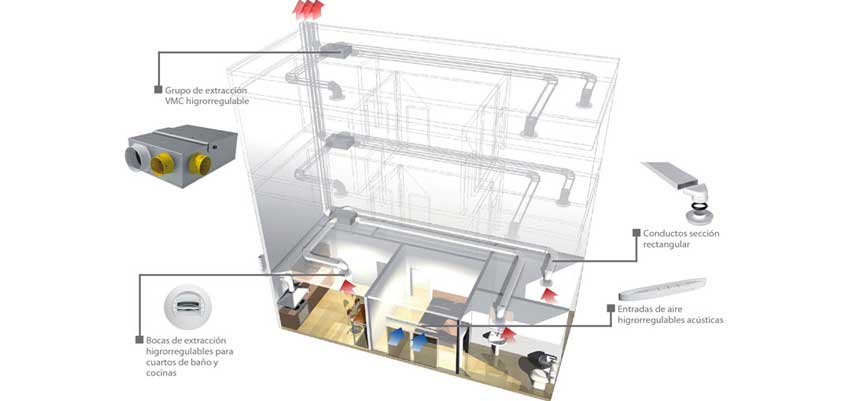
The hygro-regulable systems in mechanical ventilation are those in which their fans extract air from the rooms and then introduce only the volume of air necessary to be renewed and maintain health indoors. They allow for modifying the intake air flow based on the real and specific needs of the place at a specific moment. This way, the consumption is intelligent and moderate; only the real needs of the places to be ventilated are provided. This also translates into greater energy efficiency and savings on supplies.
The most remarkable thing about the hygro-regulable systems is that they can vary the intake and extraction of air based on the relative humidity of the interior environment, along with the detection of the number of people present in the rooms to be ventilated. The renewal of the air is constant, with a minimum in case the conditions are good.
For example, in the case of the Siber Hygro-regulable Ventilation System -which has been included for years in the Technical Suitability Document (DIT) of the Institute of Building Sciences Eduardo Torroja IETcc-, the intake of outdoor air occurs through hygro-regulable entrances that are located in dry rooms, such as the dining room or bedrooms.
The extraction of stale air, on the other hand, takes place in humid areas, such as the kitchen and bathrooms. Thus, the circulation of air goes from dry to humid spaces. Inside the home, the passage of air occurs thanks to openings in doors or in walls dividing rooms.
For this reason, it can be said that in mechanical ventilation solutions, hygro-regulable systems are perhaps the most efficient and fit the real needs of the home. They are affordable and can be installed in single-family houses or in multi-family apartment blocks.
Advantages of hygro-regulable ventilation systems

The advantages of hygro-regulable systems are remarkable, beyond the energy efficiency that comes with its use. We can list some of them based on the VMC Simple Individualized and hygro-regulable Flow System from Siber Zone:
- Ease of assembly of the hygro-regulable systems. Its installation is quite simple. The system consists of rectangular ducts of 3 meters in length with their joints and accessories. These systems have a greater ease of assembly compared to the conventional system.
- Flexibility in the sizing of the floors. Thanks to the combination of different types of elbows and accessories, it allows for the configuration of geometries overcoming different obstacles with the minimum necessary space. Avoiding obstacles guarantees a greater flow with less energy expenditure.
- A smaller space compared to other ventilation systems. Specifically, the hygro-regulable system from Siber Zone has quite reduced characteristics and dimensions. This helps avoid having something that bothers in an area of the house where we would like it to be free.
- Optimal conduction of stale air. No special material is needed to seal the ducts, which are individual. It is a smooth and also sealed system. It has a constant volume of extraction and avoids possible turbulence and backflows.
- It reduces the time of work execution. The ease and speed of assembling this hygro-regulable simple flow system means lower labor costs, in addition to saving time.
- These hygro-regulable systems also have less load impact on the flooring. At least compared to other options available in the market.
- Control of ventilation range. Each room will have a specific volume of ventilation. In a property, it will be the same. The system will adapt to what it really needs at any moment.

Siber Ventilation
Related posts

Constant flow ventilation systems, how do they work?