Double flow systems, how to optimize their ventilation?
The mechanical ventilation is the future and present of air renewal in homes and also in workplaces. In addition to being necessary and being included in the Technical Code of Building due to the tightness of current buildings, the most advanced mechanical ventilation solutions can achieve greater energy efficiency indoors and avoid the cost of traditional air conditioning. In this aspect, double flow systems are the most advanced option and offer health and clean air along with significant energy savings. Do you know how to optimize them?
The correct use of a double flow mechanical ventilation system is essential and must be customized, as it can avoid the higher costs generated in a building, that of air conditioning. Additionally, double flow ventilation is the solution that guarantees greater energy savings.
Likewise, energy regulations require that buildings become increasingly efficient, such as the imminent Nearly Zero Energy Building, which will come into force in 2020 and recommends using double flow systems to achieve the highest energy savings. Green mortgages -which offer discounts based on how energy-saving the buildings are- also require having double flow ventilation for the best rating in energy efficiency.
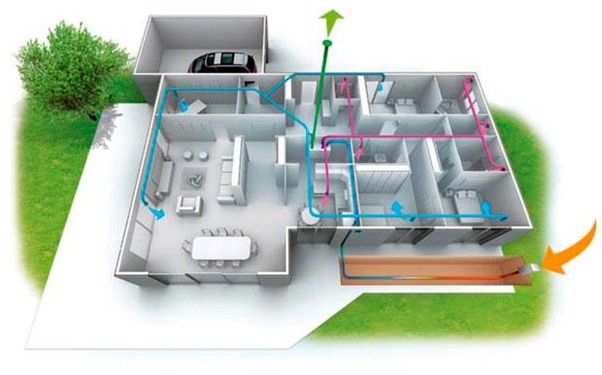
What is the operation of double flow ventilation systems? Its name comes from the two air circulation ducts, one from the outside to the interior and the other in reverse. We could summarize it as follows:
- Using probes and meters, the system knows at all times the ventilation needs, whether the environment is loaded with stale air or if there is excess humidity, among other factors like room occupancy.
- One of the ducts, through a fan, will adapt to the real needs of each room and will eliminate that lower quality air, with a constant flow that guarantees health.
- The introduction of air will be done through another duct, which will push outside air that will pass through filters beforehand. In this way, the air introduced into each room will have the highest quality and will be purified.
- Thanks to heat exchange, it can cool the air coming from outside in summer and heat it in winter.
Double flow systems can have fans coupled to the heat recovery unit or have both parts separated. The main difference between one and the other is the cost, so compact models -all in one solution- are the most widespread.
To optimize double flow ventilation systems, a series of important details must be taken into account:
- The heat recovery unit should be in a heated area, as this will prevent energy losses due to radiation from the equipment.
- If the system is compact, it is better for the recovery unit to be located in an area that is not exposed to the elements. This can cause noise disturbances.
- The best solution in these cases is to install the recovery unit in places where there is not a high occupancy. Garages or attics are two spaces where it would be less bothersome, but sometimes they are not heated places.
Optimizing double flow systems while maintaining a good noise level
As we have mentioned, noise is the main problem of double flow systems when it comes to compact equipment. What we can do is the following:- Bedrooms and living rooms are the least suitable places to install fans.
- The ducts should have the shortest possible run, as the longer the path, the greater the force on the fans.
- It is possible to install silencers and silent blocks, which significantly reduce the noise disturbances from the fans.
- Filters should be kept as clean as possible, as this will reduce the force on the fan.
- There are fans with lower noise.

Siber Ventilation
Related posts

Why is mechanical ventilation necessary in homes?

Constant flow ventilation systems, how do they work?

Discover which ventilation network best suits your project
Discover which ventilation network best suits your project Ventilation projects increasingly combine sustainability, comfort, health, and energy efficiency considerations. There is a clear objective to optimize resources. The aim is to advance along the lines of the Sustainable Development Goals (SDG 2030) and the philosophy passivhaus. Ventilation companies present projects compatible with energy efficiency and reduction of electricity consumption. This is contributed to by the overall context of crisis, with the resulting uncertainty arising from the invasion of Ukraine. Thus, for example, the government's energy security plan of Spain is a response to that reality.