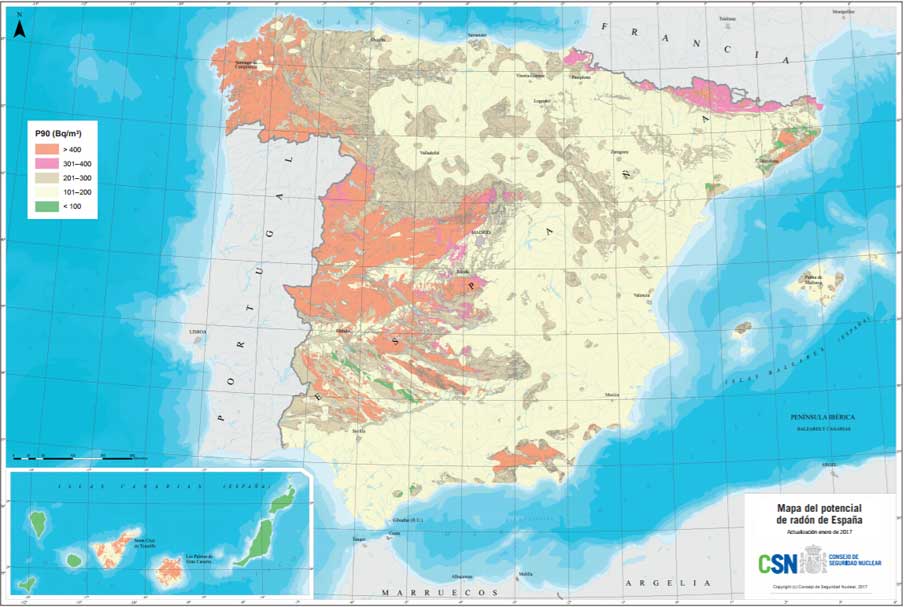
Radon map, the areas of Spain most affected by this gas
Although it is very difficult to detect, radon gas is one of the most dangerous poisons that can appear in our homes. It is colorless, odorless, and we do not realize its presence, although it is radioactive and, according to the World Health Organization (WHO), it is also the biggest culprit of lung cancers, only behind tobacco. Its presence has been known for three decades, but it is only now that regulations are being implemented to act against it. Do you fear being affected by this poison? Check what impact the area where you live may have on the radon map.
In general terms, the areas least affected by radon gas are those near the Mediterranean, where its presence is minimal and in many regions non-existent. In contrast, in central Spain and in all the area close to Portugal, the concentration of radon is very high.
That is why, starting this February, the Government has to adapt to a regulation from the European Union, the European Directive 2013/59/Euratom, to reduce the level of radon in homes. The maximum permitted threshold is 300 Bq/m3 (becquerels per cubic meter). And as an example of impact in Spain, it is estimated that in Galicia, 12.1% of homes would already exceed this limit. Under the European directive, all those properties are in danger and will have to make reforms to avoid greater harm.
What are the most serious areas on the radon map?

Above these lines, we can see the radon map developed by the Spanish government, enlarged and detailed in the link. One of the most affected areas is the province of León, whose most concerning concentration lies in the El Bierzo area, according to the National Security Council.
This is due to the large presence of slate and coal in the area, two of the elements that most favor the appearance of this harmful gas. In areas where both materials are present, the alert is greater and this issue needs to be checked.
Other areas of very high concentration are the Sierra de Guadarrama, the northern area of Extremadura, and a good part of Castilla La Mancha. Those three regions also need to be informed about the dangers of this poison.
In more specific data, the dangers of radon gas that are already concerning in homes could be said to affect 10% of all homes with the presence of this poison. And the National Security Council itself reports that around 10% of the affected homes already exceed the established limit of 300 Bq/m3. That does not mean, however, that the rest of the affected homes should not implement improvements to reverse this situation, as the concentration of gas can increase.
What does the new European regulation affect? It mandates that, starting this month, guidelines must be applied to raise awareness and reduce the level of radon gas in Spanish homes, with actions such as:
- Informative and awareness policies for users.
- Search for affected areas and detailed information on the presence of gas in the radon map that is already easily available on the National Security Council's website.
- Public assistance must be offered to those affected buildings so they can improve their home situations.
- From the Government, detection of radon gas and the degree of impact it has on homes must be facilitated.
What can we do if we believe we are in an affected area on the radon map?
- It must be noted that the most affected area is the basement, so it is important to spend the least amount of time in this part of the home if we suspect the presence of gas. At least until we have confirmation.
- What can be done from the very beginning is to improve ventilation and air the area. The area where the basement is located is primordial, but windows should also be opened in the rooms to allow air to circulate.
- In case of high concentration, mechanical extraction ventilation systems in the basement can extract radon, in addition to purifying the room and having healthier air.
- If there are leaks in the basement area, they must be sealed. Any small crack can be lethal for the entrance of gas. Likewise, the walls must be sealed so that it does not leak into the home's living spaces.

Siber Ventilation
Related posts