Passive houses: efficient and very economical ventilation
In Spain, they still seem like a novelty, but in Germany and other regions of northern Europe, they are a well-established trend. Passive houses -whether prefabricated or not- are already a tangible reality in our country. What is their greatest asset? The enormous savings on the electricity bill, thanks to their construction and an efficient ventilation system.
The term passive house comes from the concept of passive cooling, which is one that does not incorporate mechanical elements to generate heat or cold. In a car, for example, a passive element would be the radiator, and the fan an active one. In the case of homes, to avoid traditional heating or air conditioning methods, design comes into play.
Passive cooling homes make use of the orientation of the house or isolation techniques to protect their interiors from the cold and heat. In some of these houses, it is even impossible to hear the rain. And that makes heating or cooling appliances less necessary.
Some of these passive houses can be prefabricated, or others created based on the owner's needs and the place where it will be installed. But to be considered passive houses, they must be certified by the Passivhaus Institute in Germany, a pioneer decades ago in this type of housing and the reference to know that everything is in order.
However, there is a unique element that is usually mechanical in these types of houses: the ventilation. But it is not a traditional system; very efficient elements are usually installed. As manufacturers state, there is the possibility of heating a home up to 77% free of charge.
Efficient ventilation in passive houses
[caption id="attachment_3309" align="alignnone" width="904"]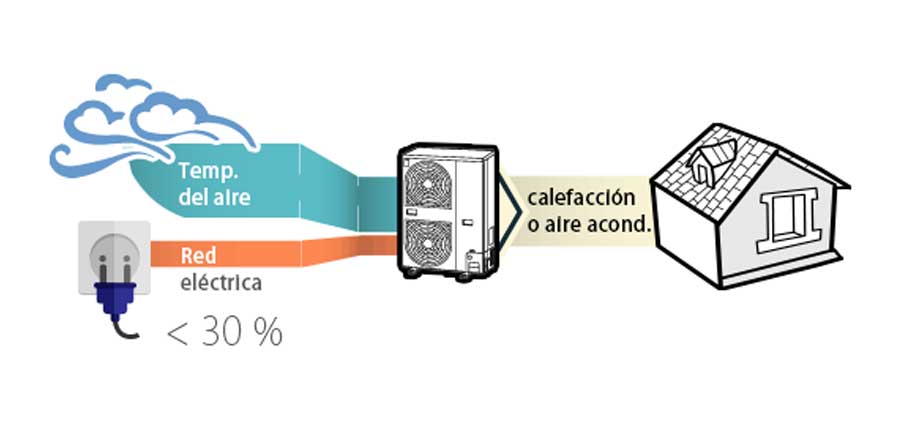 The aerothermal process used in some passive houses is capable of transforming the cold air from the street into heat for the home.[/caption]
Passive houses are already very efficient and have a specific ventilation system. This makes it possible not to need traditional heating appliances. Within the Passivhaus standard, it is very common to find the efficient system of aerothermal. What is that about?
- An aerothermal system uses heat pumps that use the outside air, even if it is very cold, to heat the room or water. It can provide cooling in summer as well.
- To do this, it extracts the energy contained in the outside air to convert it into heat inside the home. It doesn’t matter if the outside temperature is below zero.
- The aerothermal equipment can provide up to 78% of free energy, with the rest being electric.
The system it uses is electrical, mechanical, and chemical. In this way, it is capable of using the street air to acclimatize a room through its heat pump. In addition, it incorporates a refrigeration cycle to cool in summer. Who knows? Perhaps in the future, it will be the most common method for acclimatizing homes. This is how it is thought in some European countries.
It is estimated that this technology can provide heat in a passive house even when it is 7 degrees below zero outside. It takes advantage of the energy from the air, enough to change the state of the refrigerant gas inside the system that absorbs the energy to transmit heat.
Pros and cons of passive houses
Some think that the problem with passive houses is the price, but no. In reality, the Passivhaus certification costs about 3,000 euros, easily amortizable in the electricity bill.- You can opt for prefabricated passive houses or design them from scratch. You can even acquire a prefabricated part that can then be adapted.
- The options built in wood significantly lower costs. In Spain, wood is usually imported from Germany to meet the Passivhaus certification, but it is worked on in our country.
- The houses are quite silent concerning the outside, and the insulation helps. To be certified as Passivhaus, tests are carried out, such as using a giant fan in front of the facade and seeing if the interior remains warm.
- One of the challenges faced by passive households in Spain is that heating the rooms is easy, but removing the heat is difficult. The certification was born in Germany, where they do not have summers as harsh as ours.
- The aerothermal needs a passive design, and for that, it has to be installed in new-built houses.

Siber Ventilation
Related posts

Why is mechanical ventilation necessary in homes?
Constant flow ventilation systems, how do they work?