
Maintenance plans for ventilation units and ducts
Maintenance plans for ventilation units and ducts Cleaning ducts and maintaining controlled ventilation system equipment must be done according to specific procedures
Index
1. The importance of cleaning ducts and ventilation equipment2. Health and hygiene
3. Regulations
4. Safety
5. Energy efficiency
6. Proper maintenance
7. Cleaning ducts and ventilation equipment
7.1. Cleaning grills and openings.
7.2. Cleaning filters
7.3. Cleaning ducts
7.4. Cleaning openings
The cleaning of ducts and ventilation equipment translates into numerous advantages. It helps to protect health and increase well-being. In addition, it implies energy and economic savings. Controlled mechanical ventilation systems require proper maintenance. This prevents the accumulation of dust and the proliferation of microbes.
1. The importance of cleaning ducts and ventilation equipment
There are compelling reasons why duct cleaning is fundamentally important:- Air cleanliness.
- Health of the occupants or people who occupy an indoor space. Elimination of pathogens and allergens.
- Control of energy consumption.
- Increased lifespan of the equipment due to proper maintenance.
- Prevention of bad odors and dampness.
That is, similar actions must be taken in other parts of the system, such as hybrid and mechanical vacuum cleaners. Extractors, openings, and filters must also be included when performing these practices comprehensively.
For this, it is necessary to inform oneself about issues such as cleaning extraction openings or the selection, maintenance, and replacement of filters. Advancing in this process correctly ensures optimal system condition. Likewise, we protect the inhabitants of the house or the occupants of the space in question.
2. Health and hygiene
The cleaning of ducts contributes to health and hygiene in indoor spaces. So much so that the Regulations for Thermal Installations in Buildings (RITE) establishes specific requirements for air quality in buildings. These measures are initially covered in the UNE-EN 13779 standard and the CR 1752 report of CEN. In houses, those outlined in the Basic Document HS3 of the CTE apply.In this sense, issues such as the following must be considered:
- Availability of mechanical ventilation systems in buildings.
- Use of filtration systems that guarantee good quality of incoming air.
- Thermal treatment requirements.
- Indoor comfort conditions in the building or housing.
- Installation of heat recovery systems. This is needed, for example, if the flow extracted by mechanical means is greater than 0.5 cubic meters per second.
Other parts of the house are also considered, such as restrooms and bathrooms. The kitchen, storage rooms, common areas, garage, and storage or waste areas are other rooms included.
3. Regulations
As we just saw, controlled ventilation systems are subject to specific regulations. It includes various specifications to guarantee adequate air quality, as well as proper maintenance and cleaning. The reference standards are as follows:- Technical Building Code (CTE), specifically the DB HS3 document, which includes indoor air quality requirements. It applies to new constructions and renovation, expansion, rehabilitation, or modification works. It also governs buildings protected for their environmental, artistic, or historical value.
- Regulations for Thermal Installations in Buildings (RITE). It covers energy efficiency requirements. It includes design, execution, and maintenance considerations for systems, as well as their use. It also establishes mechanisms to control compliance with the requirements.
- UNE-EN 13403:2003 standard. Building ventilation. Non-metal ducts. Duct network with insulating material sheets.
- UNE 100012:2005 standard. Hygiene of air conditioning systems.
- UNE 100030:2005 IN standard. Guidelines for the prevention and control of the proliferation and dissemination of legionella in installations.
- Accessibility of systems, including ducts, for their proper maintenance and cleaning.
- Duct materials.
- Duct linings.
4. Safety
Maintaining safety throughout the lifecycle of ventilation equipment facilitates its use. But not only that, it also increases its efficiency. Article 13 of RITE states that thermal installations must take this factor into account.To do this, they must prevent accidents or mishaps in the following processes:
- Design.
- Calculation of reach and power.
- Execution.
- Maintenance and cleaning.
- Humans.
- The environment where the system is installed.
- The material assets of the house or any installation.
On the other hand, preventing corrosion and the formation of condensates are objectives pursued when discussing the insulation of the pipe network. This requires the sealing of joints, if any, and their proper distribution. The same applies to anti-vapor barriers, especially in areas such as terminals or supports. Another key safety consideration involves preventing metal contact to avoid corrosion.
Additionally, it should be considered that the insulation remains intact over the years. Therefore, it should not be compressed by the weight of the pipe, which would cause condensates and a lack of efficiency.
5. Energy efficiency
Proper cleaning and maintenance of ducts and ventilation equipment promote savings and energy efficiency. These systems balance indoor temperatures, oxygenate the air, clean it, and circulate it.The unit draws in air and causes it to pass through hot or cold coils, depending on whether we are heating or cooling the inside. Afterwards, it introduces it into the room. Dirt and dust can accumulate in any of these equipment's parts. Whether in filters, ducts, grills, or rotors, if there are many particles, it can hinder the process.
One of the most important consequences, besides efficient operation, is higher energy consumption. Some studies indicate that dirty systems consume 37% more energy. Furthermore, dirt increases the rate of wear on the equipment. This again implies higher energy consumption.
Cleaning ventilation equipment and its ducts saves us money. Performing it correctly favors equipment maintenance and reduces repair costs.
For this reason, it is important to prevent and inspect the system with the correct frequency. Replacing filters if necessary and cleaning grills are vital aspects.
6. Proper maintenance
As important as cleaning is the maintenance of ventilation equipment. This involves conducting visual inspections and ensuring optimal operation. If there is a noticeable decline in performance, noises, odors, or unforeseen problems, it is time to act. On the other hand, a significant part of maintenance is the cleaning itself. Sometimes, these tasks go hand-in-hand.There are two types of maintenance:
- Ordinary. Performed every two months by removing the cover and filter. The latter is cleaned with a dry cloth or chamois. It is also effective to vacuum it. After completing this procedure, we must replace it. The cover is secured with screws over the filter to keep it in place. In this sense, it is advisable to change filters every six months.
- Extraordinary. This procedure is carried out less frequently. Ideally, it should be performed once a year, unscrewing the cover and removing it. This will give us access to the fans and heat recoverer. Then, we remove the heat recoverer by unscrewing it. Unlike the previous mode, we now do clean it with water. However, before re-screwing the recoverer, it must be completely dry. Meanwhile, fans or motors are supervised and cleaned by removing the covering casing. We can remove and repair them if any parts or pieces are faulty, or clean them if necessary.
7. Cleaning ducts and ventilation equipment
This task requires us to be meticulous in removing dirt from each part that makes up the equipment. As we will see, this includes:- Grills and openings
- Filters
- Ducts
- Openings
7.1. Cleaning grills and openings
These parts are significantly exposed to the outside. For them to function correctly, it is crucial to maintain them in the best possible conditions. This includes the highest cleanliness standards. If not taken care of, over time, they accumulate dirt. Periodic cleaning is basic. Therefore, for optimal performance, follow these steps:First:
- Remove the grill.
- Remove the opening.
- Remove the regulator.
- Clean and dry the grill.
- Clean and dry the opening.
- Clean and dry the regulator.
- Clean the securing sleeve.
- Place the regulator back in the opening.
- Place the opening back.
- Place the grill back.
7.2. Cleaning filters
Maintaining them in optimal conditions requires cleaning them at least every six months. This ensures proper filtration. Replacement should occur once a year. In the case of these elements, the following types exist:Coarse. Made from a sheet of synthetic fiber, cotton, and polyester. Its significant advantage is its capacity to retain suspended dust.
Fine. They can be made from synthetic fiber and have special qualities for capturing pollen, spores, minute particles, and mold.
Their maintenance is carried out through semi-annual cleaning or replacement. The filter is cleaned only if indicated by a signal on the equipment screen or the LED indicator lights up.
Follow this procedure to eliminate dirt:
- Open the filter cover by pressing the corresponding button for five seconds.
- Remove the filters, being careful not to forget their position.
- Clean the filters.
- Reinsert them in the same way.
- Close the cover and press the button again for five seconds.
7.3. Cleaning ducts
These areas accumulate particles deposited over time. Sometimes, they can solidify due to moisture and temperature changes. This can significantly hinder the system's operation, hence the importance of maintaining ducts in good condition.There are various techniques to undertake this task:
- Mechanical method.
- Dry method with foam.
- Combined method. Includes mechanical systems and the use of foam.
- Cryogenic blasting.
- Visual inspection to check the state of each area. In this case, technology can be used to visualize even the last corner of the equipment.
- Work to remove dirt, with a special focus on areas with higher accumulation and essential for operation.
7.4. Cleaning openings
Just like ducts, openings are exposed to the constant flow of air. For ventilation openings, their location makes it essential to prevent water from entering from the outside. On the other hand, exhaust openings must have a separation of at least three meters. Likewise, they must have systems to prevent the entrance of animals, such as birds or insects.Due to the passage of time, extreme temperatures, or atmospheric agents, it is essential to visually inspect openings. Furthermore, a semi-annual periodicity should be respected to eliminate any trace of dirt.
As we have seen, duct cleaning has countless benefits, such as protecting health and energy saving. Performing this task well requires knowledge and experience to ensure effectiveness, safety, and comfort.

Siber Ventilation
Related posts
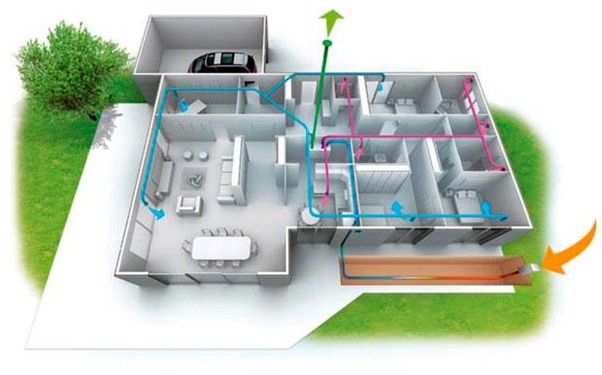
Comfort and well-being for homes, Controlled Mechanical Ventilation (VMC)

The quality of indoor air and its multiple effects on health