Excess water vapor in the air and how to choose the best humidity sensor
We are now in the middle of winter and our homes face all the problems arising from the drop in temperatures. For example, the effect of cold on windows and walls. But one of the biggest problems is the excess humidity that originates more strongly in the months when temperatures drop. How can we combat it? First of all, by knowing what level of water vapor in the air we have thanks to humidity sensors.
It should be noted that humidity problems in Spain are usually due to an excess, since even in dry climates, water vapor in the air is rarely very low -although for such situations a humidifier can help us-, so the issue of high humidity is usually taken into account.
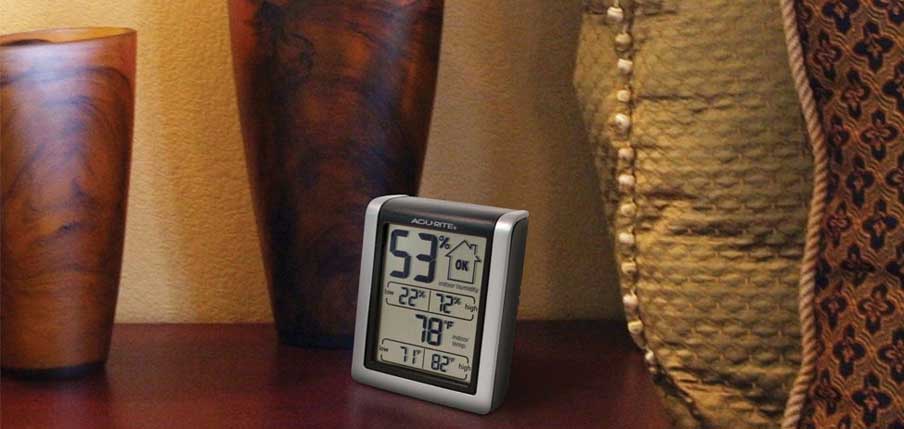
To know exactly if we have an excess of water vapor in the air, the ideal is to use a humidity sensor, which are usually known as hygrometers. There are mechanical, infrared, capacitive, or resistive ones, among others.
However, how to choose the best humidity sensor for our home? It will be different for each specific case, always depending on our needs. But we could take into account the following factors:
- Accuracy of the hygrometer. There are analog and digital ones, and in principle, the latter are more accurate than the former. Normally, all have a margin of error, but depending on how they are, they may be more or less accurate. In some cases where we simply want to know if there is an excess of humidity or not, we could use the analog and less accurate ones.
- Response time of the humidity sensor. Depending on temperature and humidity changes, sensors will take some time to adapt to new conditions and assess whether there is an increase or decrease. In mechanical ventilation systems connected to sensors, it is better to have those with a shorter response time.
- Repeatability. Do you want to know if your humidity sensor works optimally or is more reliable? For that, repeatability will help you. It is understood that if at different times with little time difference the value given by the hygrometer is the same or almost the same, it is a good sensor.
- Operating ranges. There are some hygrometers that measure processes of very high intervals. Normally, they are not the best option. And they will not be reliable in small intervals, so they may give us inaccurate figures.
- Resistance to air. Some humidity sensors are too sensitive to external factors, such as smoke when cooking or using cleaning chemicals. Filters or protections can be used so that the impact is less.
How to combat excess humidity in our homes?
The humidity sensor is a great ally in our homes, as it provides us with accurate data about something that affects homes but above all people's health. However, after detecting the humidity, we must know how to combat it, since many common methods are unsatisfactory and a solution that worsens the humidity problem in the long run should be avoided.How can we reduce humidity in the home?
- It is necessary to identify the problem and not cover it up. If there is a wall or a ceiling with humidity stains, it should not be painted over. Such action would only hide the problem, but the humidity would surely reappear.
- Layers of paint and anti-humidity products do not work either. What is necessary is to identify the root of the problem.
- Ventilation is essential to renew the air and eliminate the excess humidity. Ventilation systems are the best solution for this.
- The stale air is a great enemy of closed spaces and encourages the formation of humidity; it is important to renew the air at all times when cooking or cleaning the home.

Siber Ventilation
Related posts
Air Purifiers: Functioning and Possibilities in Our Home
Bathroom fan to renew the air in humid rooms