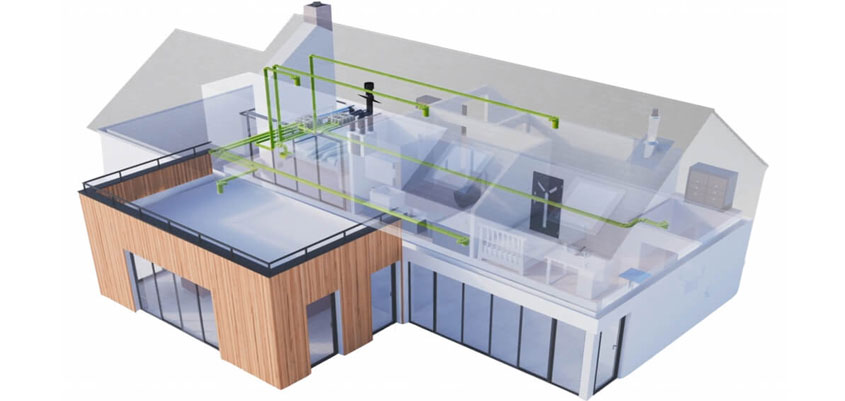
Efficient and Sustainable Forced Ventilation Strategies
Ventilation is not just a matter of regulations. Due to increasingly restrictive regulations concerning sustainability and the environment, newly constructed buildings are becoming more airtight and better insulated (thermally and acoustically). This makes them highly energy-efficient. However, this airtightness conflicts with the necessary renewal of the indoor air of spaces. In this article, we explain how a forced ventilation is essential to dilute the pollutants present in the indoor environment of the spaces.
Hybrid Ventilation and Forced Ventilation
There are three types of ventilation: natural ventilation, hybrid ventilation, and forced ventilation. The first consists of ventilating spaces simply by opening a window. The second, also known as stratomechanical, takes advantage of the conditions of the Venturi effect so that when thermal draft occurs, the spaces are ventilated. If external conditions do not promote this phenomenon, the system is responsible for extraction by mechanical means. It is a very used system in rehabilitation projects as it improves the ventilation of spaces without the need for construction.The third, forced ventilation (or mechanical ventilation), is the most efficient. Within forced ventilation, there are single flow and double flow systems. In the first, the supply is produced naturally, through self-regulating or hygroscopic air inlets, and extraction takes place mechanically, through self-regulating or hygroscopic extraction vents that depend on a mechanical extraction group (or equipment). In the second, both supply and extraction occur by mechanical means. For multi-family buildings, there are two options: either each residence has its own extraction equipment (individualized system) or they all share the same one (centralized system).
Efficient Ventilation
There are different strategies to achieve efficient ventilation.The most advanced mechanical processes for efficient ventilation exhibit some or all of the following characteristics: air renewal through variable flow, hygroscopic devices that adapt to occupancy, passive strategy mechanisms (bypass or night cooling, to avoid penalizing overheating), and heat recovery devices.
VARIABLE FLOW SYSTEMS
They allow the ventilation flow to adapt to the needs of each moment.HYGROSCOPIC SYSTEMS
They adjust the flow based on the occupancy of spaces, using the relative humidity rate as reference.HEAT RECOVERY SYSTEMS
Thanks to energy exchangers, air is continuously renewed in winter. During the process, the extracted air transfers energy to the supply air (it tempers it), taking advantage of the heat from inside. In summer, a bypass achieves cooling the environment by utilizing the moment when the outside air is coolest, that is, during the night.What Happens If I Don’t Have Enough Space?
There are forced ventilation strategies on the market designed for rehabilitation works that do not have sufficient space:- Compact ventilation systems where there is no need to install a false ceiling throughout the home; it is enough to have a small accessible and registerable space.
- Decentralized systems, where each dwelling has its own ventilation equipment. This is an element installed in the envelope wall that incorporates supply, extraction, and a heat recovery unit.

Siber Ventilation