Nearly Zero Energy Buildings, Necessary Requirements
As of this year 2018, building construction has a new obligation. As we have previously mentioned, energy efficiency in construction has led to the fact that all new public buildings will have to be of nearly zero energy consumption. This obligation will extend to private buildings and new housing in two years.
The commitment to nearly zero energy construction arises from the need to minimize energy use in buildings, which accounts for approximately one-third of total energy expenditure worldwide. These new green buildings are those that comply with European legislation in the Directive 2010/31/EU, which outlines the necessary measures to reduce energy consumption by 2020.
What does this mean in practical terms? It means that buildings that comply with the standard will have such a low energy demand that it is practically negligible. Moreover, the sources from which they obtain energy will be renewable. The building itself can have energy sources to partially self-sustain. All in accordance with the previous Kyoto Protocol and the subsequent Paris Agreement.
The first thing to consider, obviously, is to invest in energy sources that are environmentally friendly. Nearly zero energy buildings must include significant implementations in mechanical ventilation systems, airtight construction designs that prevent the effects of seasonal changes, reduced air conditioning demand, and an intelligent lighting system. All of this must be configured in an integrated system, with all parts connected.
When rehabilitating buildings, they will also be affected by the nearly zero energy consumption regulations, even for private use, but starting from 2020. There are already European countries that have implemented this standard, but in Spain, any private dwelling that wishes to be rehabilitated in two years will have to adapt to the regulations. A significant change for which it is essential to be prepared.
Necessary Specifications for Nearly Zero Energy Buildings
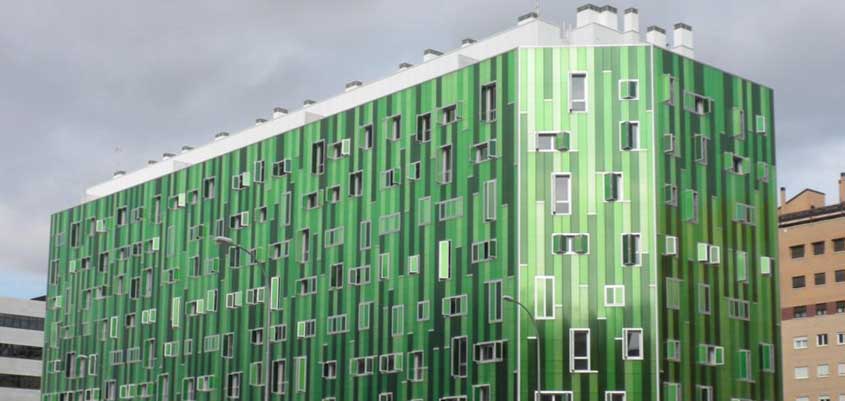
In two years, we will see how private sector builders adapt to this new ecological construction. While in other countries adjustments have been made progressively, in Spain, builders have been warned for years, but the adoption of these practices has been almost non-existent.
Now, with the obligation in the public sector, the path is opened. However, private sector builders will have to adapt very quickly starting from 2020 if they have not followed these guidelines until now. Without the European Union's measure, it is likely that nearly zero energy buildings would not have achieved notable success.
Although the European Union sets the guidelines, in our regulations, we have everything necessary to implement this new type of construction. For nearly zero energy consumption construction, while we can follow the European directive, it is actually in the Technical Building Code and the RITE, the Regulation of Thermal Installations in Buildings, where we find all these regulations specified and adapted to our territory. In the case of the CTE, the document to follow is DB HE.
To achieve nearly zero energy buildings, as we have said before, it is not enough to apply one type of installation or a specific system. We must commit to an integral model that incorporates a series of aspects within the building that will completely condition it:
- Controlled and ecological lighting. It is not just about having ecological bulbs or installations with lower energy demand. Nearly zero energy construction proposes real changes in how we understand building. There should be a commitment to natural lighting that lets in maximum sunlight. In addition to that, home automation will be necessary to automatically turn lights on and off, always based on actual needs.
- Minimal climate control. In this regard, the most important aspect is to invest in passive cooling in summer and benefit from a tight construction in winter. It is necessary to prevent heat and cold from entering through systems that do not consume energy. If the building is constructed in an energy-efficient manner, we can have ventilated roofs and other types of mechanisms that make the use of air conditioning or heating appliances unnecessary. At least in most cases. Solar panels can also be present for the performance of climate control systems, but it is essential to have very good thermal insulation and that the building is oriented to suffer less from temperature changes.
- Efficient ventilation systems. A third of energy consumption will occur due to the use of ventilation, so we must choose the system that best suits the needs of the ecological building very carefully. For this, it is advisable to use double-flow systems that harmonize with the other two aspects previously mentioned: lighting and especially climate control.

Siber Ventilation
Related posts

Constant flow ventilation systems, how do they work?

Discover which ventilation network best suits your project
Discover which ventilation network best suits your project Ventilation projects increasingly combine sustainability, comfort, health, and energy efficiency considerations. There is a clear objective to optimize resources. The aim is to advance along the lines of the Sustainable Development Goals (SDG 2030) and the philosophy passivhaus. Ventilation companies present projects compatible with energy efficiency and reduction of electricity consumption. This is contributed to by the overall context of crisis, with the resulting uncertainty arising from the invasion of Ukraine. Thus, for example, the government's energy security plan of Spain is a response to that reality.