Double flow ventilation systems, how to optimize them
The search for greater energy efficiency leads us to choose mechanical ventilation solutions that go further. In a home or professional places, the consumption derived from optimal ventilation is always high. And if there is an option that allows us to save much more, it is the double flow ventilation systems.
Moreover, with the changes in regulations and environmental requirements, double flow systems are established as one of the best alternatives considered ecological, as they consume much less energy. With the help of regulations in favor of ecological energy, they have also become an important future bet.
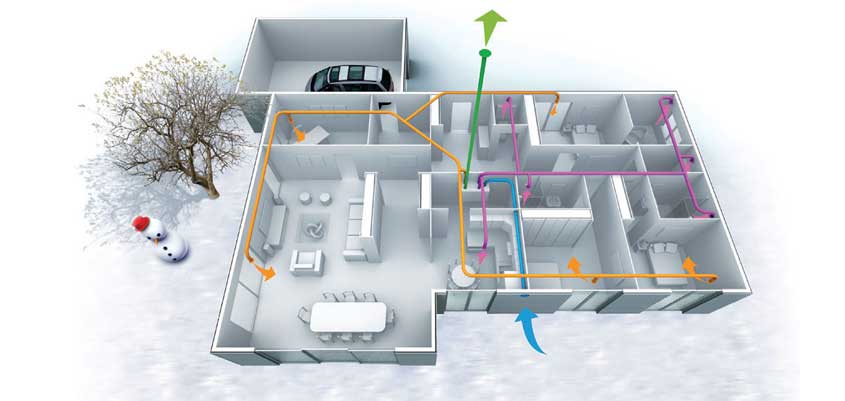
As we already mentioned in this special on double flow ventilation, this system is called this way because it is capable of extracting air to the outside and also introducing renewed air mechanically by itself. This solution also comes with a heat recovery unit that connects the incoming and outgoing air flows, making it considered energy efficient.
With double flow ventilation systems, it is possible to save energy in winter and also in summer.
What inconveniences does this ecological solution have? Basically, since it is a mechanical ventilation system, if they do not have a good design and sizing they could end up being noisy. Even so, we can do quite a bit to optimize their use and enjoy their comfort silently, as well as ensuring that the equipment performs better.

Maximize the use of double flow ventilation systems
In double flow ventilation systems, we find that the most economical solutions are the ones that usually generate a higher level of noise. In homes and especially in rooms where a lot of life occurs, it can become a problem.Primarily, we find two types of double flow ventilation solutions available:
- Independent double flow ventilation systems. In these cases, the fans that will circulate the air to introduce and extract it are separate from the heat recovery unit. They require a larger installation.
- Compact double flow ventilation systems. In this case, the extractors and fans are connected to the recovery unit. They are simpler and have less complexity.
To operate at the best performance, the heat recovery unit of the double flow system must be installed in a heated area, as energy losses must be avoided. What problem arises here? Compact systems install both fans, the extraction and the introduction, necessarily close to the heat recovery unit. This can cause unwanted noises and sounds very close to where the house is.
What can we do? Look for an area for the fans and the heat recovery unit that partially or almost entirely eliminates the noise generated. For this, obviously, independent systems yield the best results. This way, the heat unit can be in a heated area and the fans in a place that doesn't disturb.
Being much more flexible solutions, independent double flow ventilation systems allow for the heat recovery unit to be installed in a climate-controlled area. This way, a possible loss of energy due to temperature differences between the outside climate and the inside can be avoided.
In the case of independent systems, we can install fans in uninhabited areas. It could be in a parking lot, for example, or in basements and attics.
Similarly, independent units are more generous with space and take up less of the avoidable area. They are more convenient as they can be installed in less crowded areas.
With all double flow ventilation systems, we will achieve the following advantages:
- The main benefit will be energy efficiency, with savings in supply costs and also intelligent use of energy.
- Thanks to the air filters that the system incorporates, we can enjoy cleaner air and avoid respiratory discomfort in the home.
- We will introduce conditioned air thanks to the heat recovery unit.
- We significantly reduce the use of combustion systems or air conditioning.
- Minimum consumption, uses the same as the standby of a television.


Siber Ventilation
Related posts