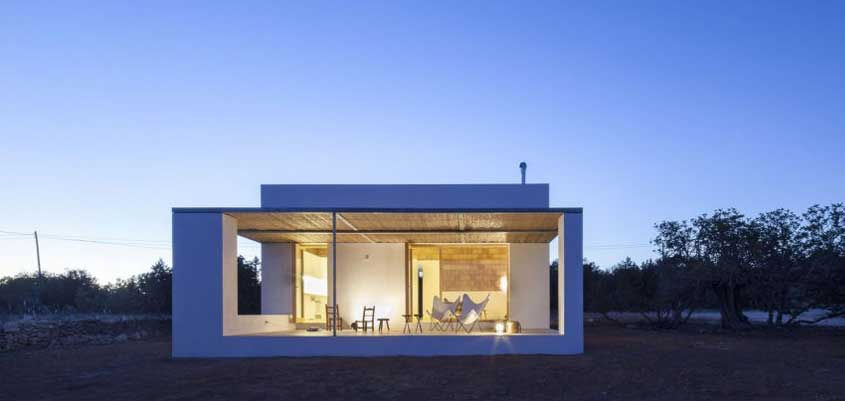
Cross ventilation or how to stop heat in summer
One of the most common efficient systems in bioclimatic houses is undoubtedly cross ventilation. Many modern buildings as well as homes incorporate it, as it is one of the best ways to combat heat in summer without the need for intensive use of air conditioning units. What does this system mean?
We must start from the basis that all buildings are ventilated by outside air. And that there is an entrance and exit of air from the street to the interior. Even in the oldest and poorly constructed buildings, as there are materials of varying porosity. Energy efficiency in this area influences, in particular, how to regulate the air that enters and leaves each property.
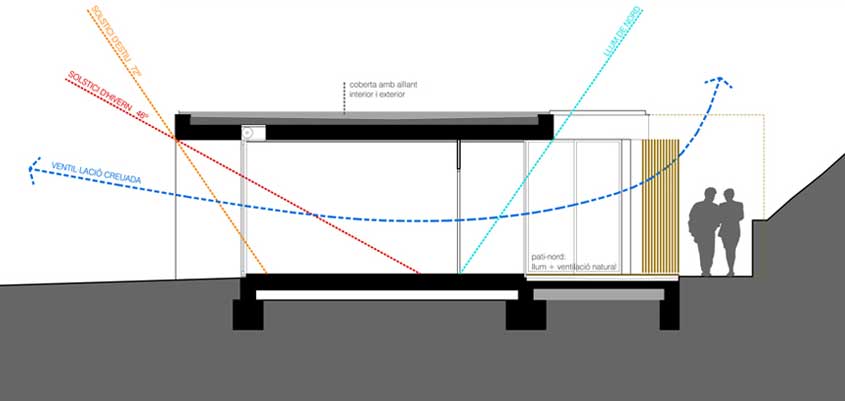
Cross ventilation consists of slowing down the advance of warm summer air in order to keep a room better cooled. With some small modifications in buildings, better temperatures can be achieved. To do this, it must be taken into account:
- The southern facade of homes has warmer air currents.
- When it is hot, warm air rises up.
To eliminate warm air from the lower area, channels are installed to send warm air from the ground to the upper part and outside the home. Similar to vents, the idea is to prevent hot air from being trapped.
As we have said, the southern facade suffers from warmer air, so ideally, the windows that allow wind to enter should be positioned to the north. With these modifications, much has already been gained regarding how we ventilate the house.
The use of air conditioning units will be less. In homes with cross ventilation, it is unnecessary in many cases to use electricity, as these energy efficiency measures eliminate heat. It is one of the most common methods in sustainable buildings.
Examples of cross ventilation in sustainable architecture
Cross ventilation is, as we have said, one of the most interesting systems to make a building efficient. There are numerous projects that serve as examples, some of them of Spanish origin.
 A good example is the skyscraper shown to the right of this paragraph. Its name says it all: it is called The Wind Tower. And it is located in Kuwait, where stopping sun rays and warm air is much more than a necessity.
It is built by AGI Architects, a Spanish-origin studio with offices in Spain and in the Middle Eastern country. And the maxim of this giant made of steel and concrete was always to achieve very good ventilation and to eliminate as much as possible the use of air conditioning units.
And they have succeeded. The Wind Tower is built and oriented in such a way as to avoid sun rays. Created monolithically, its maintenance is very simple, and the orientation of the windows makes it more difficult for warm air to enter.
Of course, they have made use of cross ventilation in buildings. A base of common spaces - installed in the pool and gym - serves as a vent. Like a light well. Ventilation gaps are created to eliminate warm air and let it escape outside.
Another interesting example of a modern building that uses cross ventilation is the future university residence of the Polytechnic University of Catalonia. Located in front of the Diagonal-Besòs campus, it will use cross ventilation. And the construction works will begin in November.
[caption id="attachment_3354" align="alignright" width="845"] The future university residence of the UPC, in model.
The building will be constructed using Passivhaus passive house certification, one of the most important labels for sustainable buildings. It will be flanked on the ground floor with landscaped green areas, which will help with ventilation. But the entire structure has been designed taking into account air inlets and outlets.
This will be a great achievement in sustainable buildings. The facades will be made up of white painted concrete panels, combined with pastel-colored aluminum panels for the fixed cladding, especially on the north and south facades. Making use of cross ventilation to avoid higher energy expenses.

Siber Ventilation
Related posts