Benefits of the enthalpic recuperator and its main uses
The heat exchange or those factors that affect temperatures is one of the main functionalities of mechanical ventilation systems based on energy efficiency. Its operation is simple: it tries to temper spaces in summer and winter to avoid the need for traditional air conditioning systems, either by providing heat or cold or modifying the factors that influence how we feel the temperature.
And among the different types of temperature exchange, we can find the enthalpic recuperator, whose main function is the partial recovery of humidity, which can be used in homes, offices, or commercial places.
The partial recovery of humidity allows that in winter the air entering the spaces has better relative humidity conditions after passing through the heat exchanger. In this way, it is not necessary to provide humidification of the supply air flow.
In summer, the effect sought with the enthalpic recuperator is a certain "drying" of the outside air flow. Thanks to this, we can avoid the energy expenditure that it entails to dry it, for example, with air conditioning.
In all cases of use of the enthalpic recuperator, consumption is very moderate compared to traditional air conditioning systems. This is why the installation of this solution is something to consider in places where humidity modulation is required. In winter, it is also capable of significantly improving the conditions of relative humidity indoors, making it highly recommended as a comfort element. Furthermore, with heat or humidity recovery, it is possible to achieve significant savings in energy costs, which is recommended for Nearly Zero Energy Buildings, which will be mandatory from 2020 for all constructions in Spain.
It should be noted that enthalpic recuperators can only recover existing humidity. By this, we refer to the fact that their installation will not be the same in an office as in a home, since workplaces with office workers do not usually produce humidity as happens in a home, where there are humid rooms such as bathrooms or kitchens. To avoid creating overly dry environments, it is important to take this into account when installing the enthalpic recuperator.
An enthalpic recuperator differs from a conventional heat recuperator in that normal ones only use sensible energy, which we perceive as cold or heat. Enthalpic recuperators, on the other hand, use latent energy such as the humidity of a space.
How does the enthalpic recuperator work?
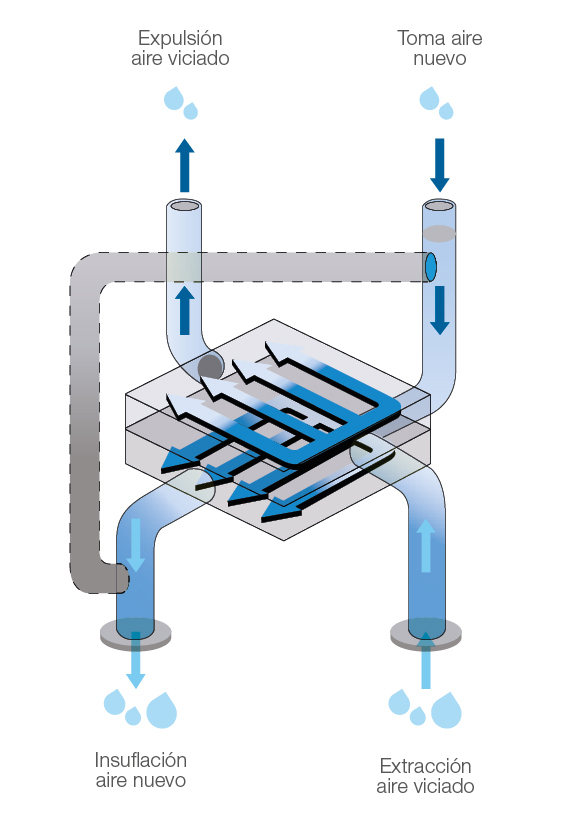
The operation of the different heat recovery systems is quite simple and makes use of the psychometric properties of the interior of a space, its temperature and humidity.The efficiency of an enthalpic recuperator will mainly depend on the following:
- The temperature and humidity conditions inside the space. If there is good airtightness, the recuperator will obtain a more tempered air with which to acclimatize the incoming air from outside.
- The use of humid and dry spaces. One must consider whether the project where the recuperator will be installed is an office or a restaurant, for example. Or the type of housing it is.
- The temperature and also the humidity outside.
- The flow circulating through the ducts will influence the air conditioning capabilities of the enthalpic recuperator.
- The design of the installation will also influence how much heat it will be able to recover, with a necessary balancing of the extraction and admission flows.
We find several types of enthalpic recuperators as follows:
- Enthalpic recuperators with rotors. It can achieve recovery in summer in humid places like the coast. It recovers humidity so that it does not enter interiors, and in the case of dry places like the plateau in Spain, it prevents moisture from escaping in winter. It has a significant energy recovery, with sensible of 70% and enthalpic of 60%. It is resistant to freezing. Its electrical consumption is more expensive.
- Passive mode enthalpic recuperators through the walls of the ducts. It can achieve recovery in humid places in summer and dry in winter, like rotor systems. They include a bypass to avoid humidity recovery in humid climates when the outside air is drier than the inside. However, it is more expensive to install and its sensible performance is somewhat lower.

Siber Ventilation
Related posts

Why is mechanical ventilation necessary in homes?

Constant flow ventilation systems, how do they work?