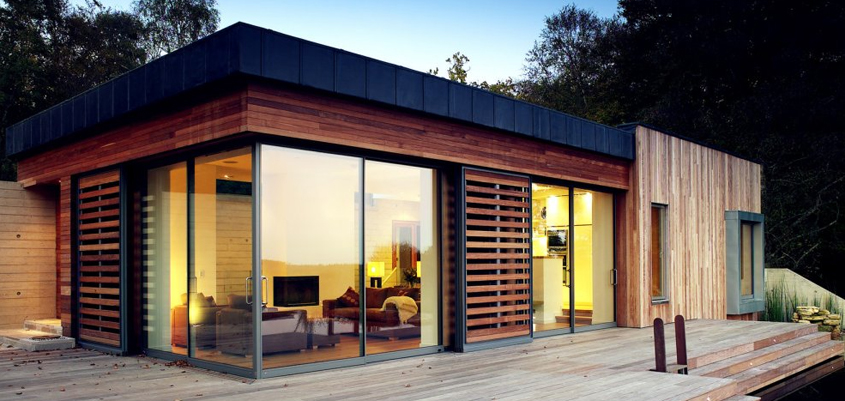
Bioclimatic architecture, how to build sustainable houses?

superadmin
June 24, 2017
Sustainable houses are those constructed considering the environmental conditions in which they are located, to achieve maximum indoor comfort with the minimum possible energy demand. The goal is to minimize the energy bill for climate control (heating and cooling) by employing the natural resources offered by the surroundings, thanks to good orientation and increased insulation of the envelope.
Sustainable houses: the importance of collection, accumulation, and the use of natural resources
Sustainable houses are based on passive principles, meaning that the conservation of the indoor energy of the building itself is prioritized over the generation of new energy. It is crucial to capture energy (heat/cold), accumulate it, and use it appropriately through correct distribution. This must be applied to the building itself and to all mechanical components it incorporates.The natural energies used when constructing sustainable houses are part of a cycle, since much energy is generated at certain moments and none at others. To optimize the collection processes of energy, it is best to accumulate it as it is captured. The building itself (its materials and its envelope) serves as the basic accumulators in bioclimatic architecture.
The following will be sought: • Place the thermal insulator on the outer face of the envelope. • Use materials with high diffusivity and thermal effusivity, such as stone, metals, or ceramics. A material with high thermal diffusivity will have the capacity to heat up quickly; a material with high thermal effusivity will have a high capacity to store energy. • Use water as a heat store. • Take advantage of good orientation to meet lighting demands, utilize the solar thermal energy, and avoid overheating in summer in warm climates.
The importance of good orientation
Depending on the type of energy to be captured (wind or solar), both the capturing devices and the building itself will have a specific orientation. If the aim is to maximize radiation, in our country the best orientation is south. If wind energy is to be utilized, the orientation towards the dominant winds must take precedence.How to avoid overheating of the roof
Flat roofs are continuously exposed to solar radiation. In the summer, moreover, the rays that fall on it during peak radiation times do so at an inclination close to 90°. One way to avoid overheating of the roof during summer is to have ventilated roofs or covered with a vegetation layer.Collection systems
The glass in the joinery also acts as capturing systems. They can be made more efficient if spaces are created that act as large air chambers, such as glazed galleries or the Trombe wall. The goal is to achieve a greenhouse effect, so that rays penetrate the space and energy is captured but cannot escape back out. This way, the space gradually releases it to warm the environments.Active energy capturing mechanisms are advisable as a complement to passive systems. If the aim is to obtain hot water (ACS), flat collectors should be used. If the goal is to generate electrical energy, photovoltaic panels should be utilized.


Siber Ventilation