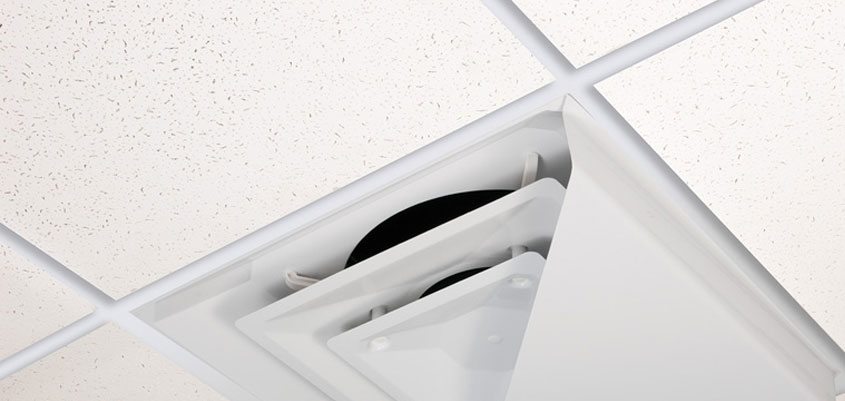
Air diffuser, placement and importance in ventilation
In mechanical ventilation, many components influence the installation to achieve the most harmonious and efficient design. From the length of the duct network and its design to air filters, through less visible elements like fan silencers. One element that may seem less important is the air diffuser in ventilation, which is placed to direct the air.
In everything related to air pathways, diffusers are the places where the air will finally be displaced after being propelled. We can find them in almost all elements related to air propulsion, such as any air conditioning equipment. Thanks to them, the air will be directed in one direction or another.
In the sector of mechanical ventilation, the concept of diffusers is more related to ventilation grilles and extraction mouths in mechanical systems, as they are the panels placed at the final end of the air intake in the first case and of propulsion or extraction in the second.
Their function as an air diffuser is because they can regulate the air flow and its direction. We find simple solutions that simply let air pass through to options that can even control humidity.
How do air diffusers work? It depends a lot on the type of design they incorporate, usually they are tubular and rectangular, both allow directing the air from a duct to a room. Air is first extracted or sent through the ducts, to then be distributed through adjustable grilles with a specific inclination or nozzles that will vary depending on the type of system. Some of the most used models operate in six directions, three directions and in the form of propulsion mouths.
In the market, there are different types of air diffusers, among which some very common ones are:
- Ceiling diffusers. They are installed recessed in the ceiling and we only see the outer grille if the structure can be hidden in the false ceiling, being visible in solid ceilings.
- Wall diffusers. Recessed with perforations to push the air.
- Tubular diffusers. They have visible ducts and allow the air to be emitted directly from the duct.
- Grille diffusers. They can be adjustable or fixed grilles.
- Transfer diffusers. They have acoustic insulation for greater sound comfort.
- Low-speed diffusers. They offer better comfort if the fan is at a short distance.
- Floor diffusers. They can push or expel the air.
Choosing an air diffuser for our mechanical ventilation installation will depend above all on our needs and especially on the type of construction. In systems where air intake is done manually, ventilation grilles will be sufficient. However, it must be understood that the type of diffuser will significantly influence how air enters and is distributed throughout the rooms.
Extraction mouths as models of air diffusers
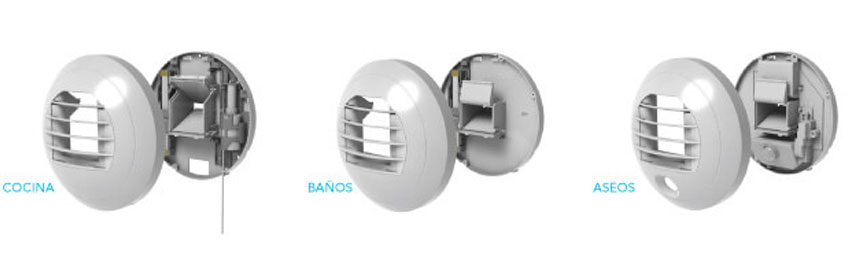
Extraction mouths in mechanical ventilation systems are a type of air diffuser responsible for efficiently extracting stale or contaminated air indoors. They are usually installed in humid areas of homes, such as bathrooms and kitchens, and can adapt to the specific needs of each moment and even eliminate humidity.
Self-regulating extraction mouths have regulators that maintain a constant nominal air flow, regardless of factors like pressure. They are the most used in controlled mechanical ventilation installations to extract poor quality air from humid areas. They work in both single flow and double flow systems.
For rooms where humidity may be a problem, we can install hygro-regulable extraction mouths, which will extract excess water vapor from the air. This type of mouth that functions as an air diffuser in extraction is characterized by incorporating a device that allows variation of the air flow according to humidity levels. Their operation can be electric, with batteries or cord. They can also work in such a way as to eliminate excess noise and improve the acoustic volume of each room during operation.
Whether ventilation grilles or extraction mouths, it's important to consider that the function of air diffuser is crucial in any mechanical ventilation installation. Therefore, it is worthwhile to conduct a situational study independent of each home to provide the best air renewal solution.

Siber Ventilation
Related posts

Why is mechanical ventilation necessary in homes?

Constant flow ventilation systems, how do they work?