The first Passivhaus in Spain in extreme climates
In the trend of sustainable houses, there are different certification seals to guarantee the sustainable qualities of the house itself. Some of them have already become references, such as the Passivhaus model of passive houses. This German-origin seal is one of the best known, and we can now say that in Spain, the milestone of achieving the first Passivhaus in extreme climate within our country has been reached.
It can be said that this is an important feat because one of the most characteristic traits of Passivhaus is that it is a certification that works better in cold climates. In fact, it is designed for that, as it originated in Germany and spread strongly throughout northern Europe.
In Spain, on the other hand, we have the challenge of achieving passive houses in some very warm environments. The difficulty comes from the passive houses themselves, which cannot use energy and must be sustainable with ecological technology. The only system that uses electricity is the mechanical ventilation system with heat recovery. And although the benefits of this installation are always discussed for combating the cold in winter, the same system is also very effective in summer.
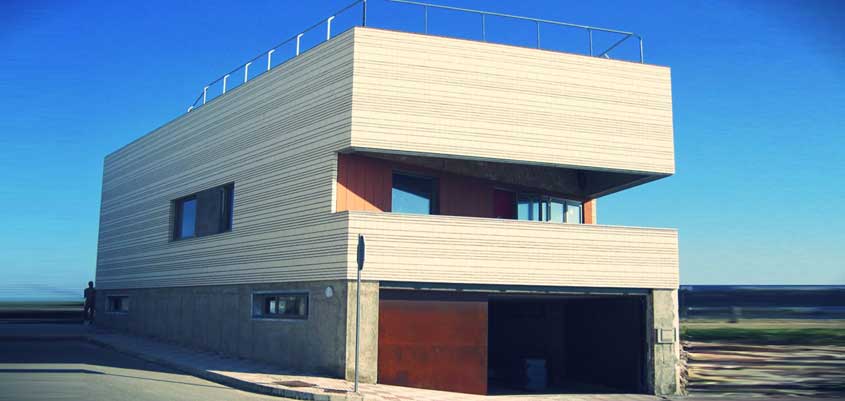
It has been proven that a Passivhaus can be prepared for extreme heat environments. Thus, a house has been built in Herrera, a locality very close to "the frying pan of Andalusia," where temperatures can reach up to 45ºC in summer.
To do this, the standard had to be pushed to the limit to achieve the first Passivhaus that would survive the harshest summer, with a line of technologies that would help achieve that. The house features a large skylight located in the center of the living area, and thanks to the orientation of the house, the skylight is used to heat the house using solar energy. Additionally, it has a movable shade that is open in winter and completely closed in summer to avoid excessive solar radiation.
The house in Herrera, in which Siber Zone participated with the integral ventilation solution, features the following sustainable advancements to be passive in such a warm environment:
- North orientation. The main facade is oriented in such a way that it avoids solar radiation. The aforementioned skylight achieves the shadow effect for the sun's rays.
- Ventilated facade. It has perforations that allow ventilation from the outside, thus reducing heat thanks to the circulation of air inside.
- It also has a ventilated roof that allows warm air to escape there as well.
- All windows are motorized with shades, completely avoiding direct radiation inside the house. The temporary shading factor reaches 13% in this case.
- The house also makes use of geothermal energy. Buried in the basement, there is a geothermal heat exchanger.
- The design of the windows allows for good cross-ventilation. The skylight features a motorized operable window that draws air from the rest of the windows in the house.
Characteristics of the first Spanish Passivhaus in extreme climate
The materials and construction systems used in the first Passivhaus in extreme climate -you can find more information here- are those available in the area, as sustainable construction focuses on acquiring materials from nearby sources. The exterior closure is made of ventilated brick, typical of Andalusia, for example. The unheated basement was constructed using reinforced concrete with 10 centimeters of insulation on the outside.
The air tightness is resolved with 2 centimeters of plaster. And with good execution, it results in very good results in the airtightness test. Reflective insulation has also been used to resolve thermal bridges in columns and floor front, combined with other systems.
Ventilation is a main pillar in these passive houses, as with the correct extraction of stale air and the introduction of filtered outside air, it is possible to reduce heat in summer and improve warmth in winter. The energy use is lower, and only in some cases, on very cold days, will the use of extra energy be required.
Heat recovery ventilation systems are ideal for all sustainable house projects. They are also suitable for other seals like BREEAM. In this type of ventilation, the most advanced today, we can measure exactly our air needs and adapt the flow accordingly. A perfect solution for Passivhaus and other ecological construction seals.

Siber Ventilation
Related posts