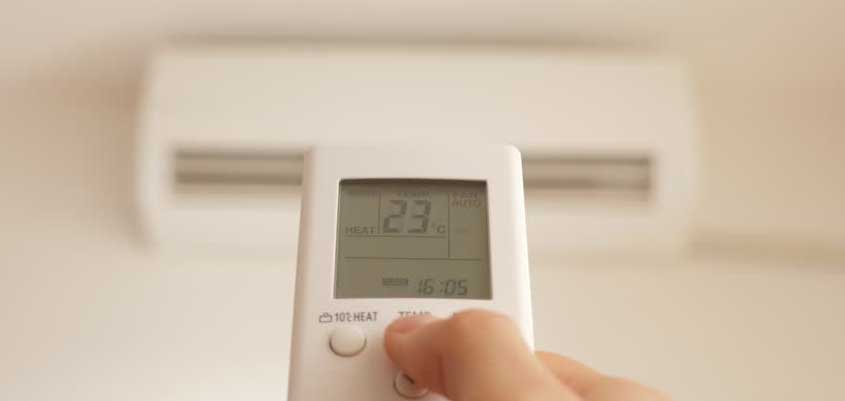
Why is a ventilation system better than using air conditioning?
Air conditioning systems are known for being the usual appliances to cool a space. Without a doubt, they are the most common anywhere. But they are also recognized as the ones that consume the most and waste the greatest amount of energy. They are far from energy efficient, although they are capable of cooling a space to a minimum.
What is the alternative to air conditioning? For many, it is the fan. But a normal fan can only move air, not renew it and, while it is economical, it does not provide a good sense of comfort at home.
If there is a solution that is indeed capable of replacing air conditioning in terms of well-being and enjoying good temperatures at home, it is the one provided by mechanical ventilation systems. And especially the double flow systems.
The main difference between air conditioning units and mechanical ventilation systems is that the former cool the air of a space while the latter renew it.
In many cases, even in summer in our country, a mechanical ventilation system is sufficient to eliminate the high thermal sensation and enjoy a pleasant temperature at home.
Pros and cons of an air conditioning system
The air conditioning units have been used for many decades. In fact, their use dates back to the beginning of the last century. During all this time, they have been improved to greatly reduce their size, make them quieter and even consume somewhat less.Right now, air conditioning systems are installed in practically all workplaces and commercial venues in Spain and in many homes. Their size is compact -although they still need a unit in each of the places to be cooled- and they are becoming quieter.
It could be said that to cool a space, it is the most effective solution, as its operation is based precisely on that: introducing cold air.
However, this has a series of contraindications that make air conditioning units to be used sporadically:
- The operation of air conditioning requires a compressor that, when overheating, cools the gas that will then send cold air into the room. This process is not eco-friendly as it sends even more hot air outside in summer.
- An air conditioning system is not energy efficient. On the contrary, it requires a lot of energy for the process.
- These cooling units are not capable of varying the temperature of the air they send to the rooms. They usually send it at a temperature between 9 and 12 °C, and when the thermostat detects that the selected temperature has been reached, it stops and only ventilates. However, most units are not capable of measuring the room temperature accurately, so it is common for them to cool more than necessary.
- With an air conditioning system, the air is not renewed; rather, the room is cooled. So when it is no longer used, the warm air will quickly return.
- Stale air is not eliminated with these types of units but remains in the environment.
To find a formula that can ensure air renewal resulting in thermal comfort without excessive expenditure and in an eco-friendly way, the best option is a double flow mechanical ventilation system.
Advantages of mechanical ventilation
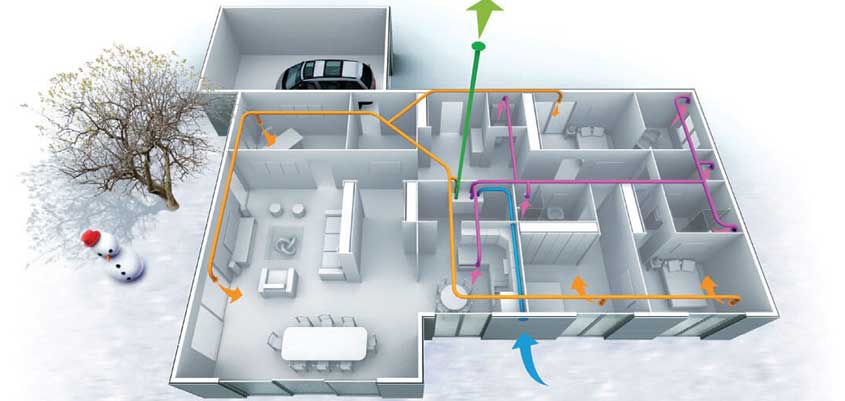
The best solution for complete ventilation of a house is double flow mechanical ventilation. In this case, cold air is not emitted to lower the temperature of a room, but rather the air is renewed, and it also arrives filtered.
In this process, circulation of air is achieved. This means that stale air is constantly being removed from the space while introducing newly filtered air.
The cooling is not as great as that of air conditioning units, but in a well-constructed house, cooling the air is not necessary. Additionally, double flow mechanical ventilation makes the home much healthier by renewing the air and only introducing filtered air.
Mechanical ventilation systems have a very low expenditure, similar to that of a bulb, making them a very efficient solution in terms of energy savings. Ventilation systems operate continuously and do not need to be used sporadically like air conditioning.

Siber Ventilation
Related posts