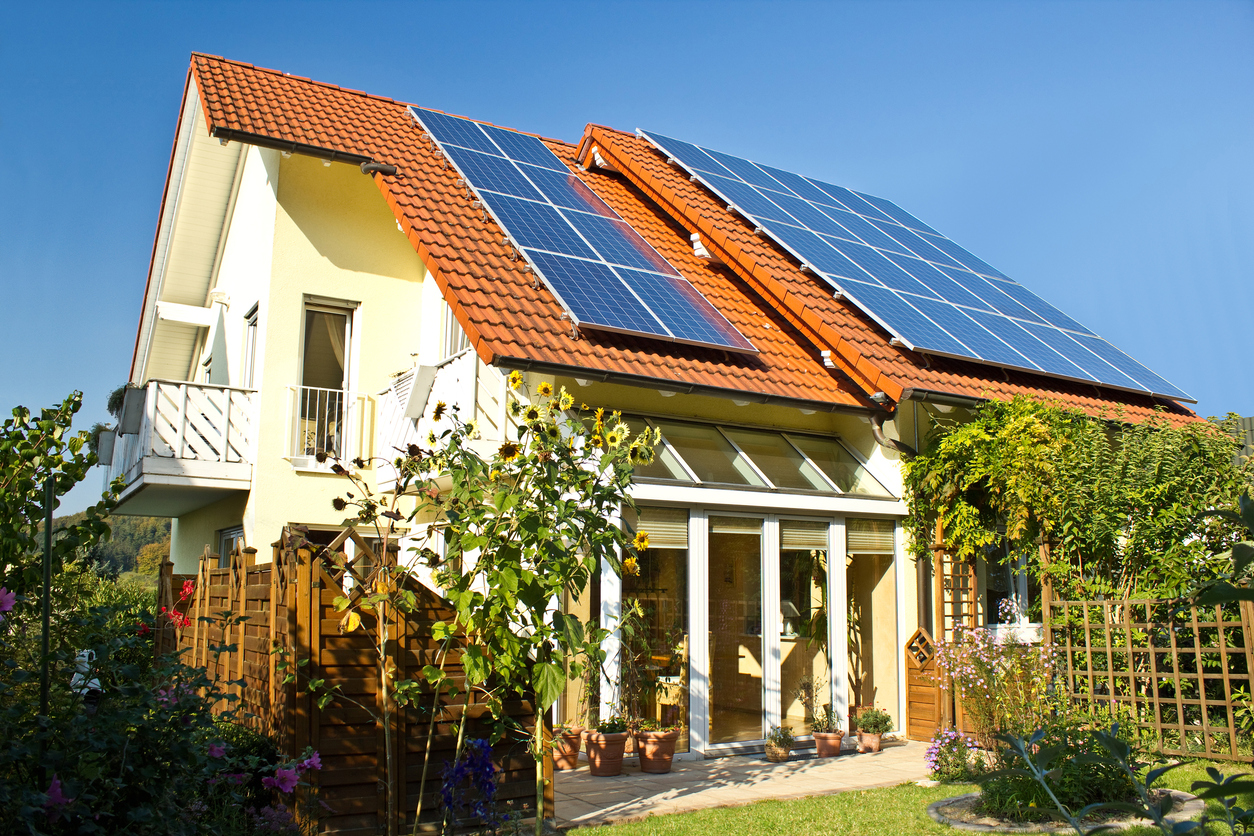
What is thermal solar energy? How to take advantage of the sun
According to the CTE DB HE 4, Energy Saving, the implementation of a thermal solar energy installation for the production of ACS (sanitary hot water) and heating is mandatory in new construction projects. It is also required in buildings that change use and whose ACS demand exceeds 50 l/daily, if the thermal installation is expanded and the demand increases from 5000 l/daily by 50%, or if the one of a covered or uncovered swimming pool is rehabilitated. But do you know what is a thermal solar installation? Do you know how it works? In this article, we explain it to you.
How does a thermal solar energy installation work in a single-family home?
A installation of these characteristics consists of the following equipment: a collection unit oriented towards noon (the solar panels themselves are arranged with a 25-degree inclination from the horizontal and such that no shadows are cast upon them), an energy accumulation unit, an energy exchange unit, a circuit through which a fluid flows, a conventional energy unit, and an electrical and control system.The system has two sealed circuits: a primary and a secondary. A fluid (water + antifreeze liquid) flows through both. The primary absorbs energy (thanks to radiation) and the secondary releases it to the inter-accumulator (thanks to a coil) and transfers the thermal energy to the individual exchanger (to heat the water of each of the boilers of the homes). Once the energy exchange occurs, this energy returns to the inter-accumulator, through an “inverted return” procedure, to ensure the stability of the secondary circuit. It is a non-direct heat transmission system, as the fluid that flows through the primary and secondary circuits is not the one that the user ultimately consumes.
Sizing of a thermal solar installation
Before proceeding with the design of the installation, the climatic sector in which the building is located must be taken into account. During periods when the energy generated by the installation itself is not sufficient to produce an ACS with an optimal consumption temperature, it is necessary to use the individual boilers of each of the homes.According to the CTE DB HE, Energy Saving, the solar contribution must fluctuate between 30% - 70%, considering that the ACS demand cannot exceed 110% during any month, nor 100% for three consecutive months.
Current regulations for the design of thermal solar energy system installations
- REBT, Low Voltage Electrotechnical Regulation and its Complementary Technical Instructions.
- RITE, Regulation of thermal installations in buildings CTE (CTE DB HE, Energy Saving).
- Regulation of Pressure Appliances and its Complementary Technical Instructions.
- Regulation of gas installations in premises intended for domestic, collective or commercial use.
- UNE Standards for Thermal Solar Energy.
- UNE Standards for Thermal Installations in buildings included in RITE.
- Technical Conditions Document of IDAE (Institute for the Diversification and Saving of Energy).

Siber Ventilation