
How to avoid the spread of COVID through aerosols
First of all, it should be noted that aerosols are small particles emitted when breathing, speaking, singing, coughing, or sneezing. In this sense, they have been considered the main culprits of the feared coronavirus transmission.
Furthermore, since their influence on the rapid spread of the pandemic was determined, much research has been conducted on various factors such as, for example, the distance these droplets can travel or the time they remain suspended in the air.
Therefore, in the following lines, we want to provide more information about how to avoid the transmission of COVID through aerosols.
Aerosol Transmission: Specific Recommendations
One of the major problems when combating the effects of aerosols is that they are barely perceptible to the human eye. Likewise, their propagation is very fast, often without us realizing it.
As stated by the Ministry of Health in one of its latest reports, the amount of virus emitted is determined by the quantity and size of the aerosols generated, the viral load of the emitter in their respiratory pathways at that moment, and the emission time.
Thus, the best way to prevent this is by properly ventilating all closed spaces where people come together.
More specifically, if ventilation is poor, aerosols not only remain suspended in the air but can also move to all corners of the room, thus increasing the risk of infection.
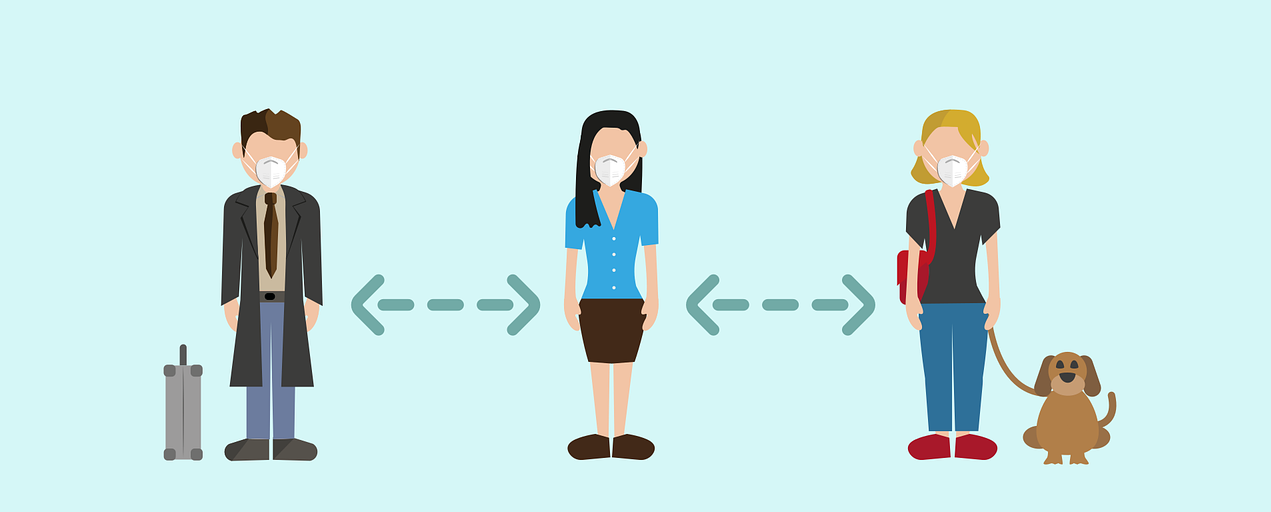
Therefore, it is essential that when you are in a closed space, you always wear a mask, without neglecting the obligation to maintain social distance.
In addition, it's important to remember that those responsible for these places must control the capacity, as people enter and exit. Similarly, health authorities also recommend avoiding certain activities and forms of interaction, such as singing, speaking loudly, or exercising, for example, in gyms.
As it cannot be otherwise, it is necessary to do everything possible to ventilate the space. Even though it's not pleasant in winter, the ideal would be to keep the windows open all the time.
What else should you know about how to avoid the transmission of COVID through aerosols?
It is necessary to consider that the scientific community has not always agreed on whether aerosols are a source of contagion or not.
However, this controversy is a thing of the past, and there is now virtually unanimous agreement. It has been demonstrated that aerosols are the main transmission factor.
Therefore, special attention should be paid to the ventilation routine. It can be performed naturally, by opening doors and windows. Furthermore, it will be more effective if done crosswise, meaning opening doors and windows on opposite sides, as this allows for greater air circulation.
Of course, mechanical ventilation is also very effective. As is evident, both systems can be combined to increase their effectiveness, without overlooking the use of air purifiers that help clean the environment to compensate for poor ventilation.
In short, we can affirm that aerosols are, as of today, the primary means of contagion of the coronavirus, as proven by science. Furthermore, the risk increases exponentially if one remains in a closed space, poorly ventilated, and for an extended period of time.
Likewise, using a mask and fully adhering to social distance are essential to avoid the transmission of COVID through aerosols.

Siber Ventilation
Related posts

Why is mechanical ventilation necessary in homes?
Documento de Idoneidad Técnica (DIT) en ventilación: qué es y por qué el DIT 597R/23 de Siber marca la diferencia